Ocean, Caspian, and Overland Freight to Kazakhstan
You move oilfield equipment, mining machinery, and heavy process gear toward the largest market in Central Asia, and Kazakhstan sits on the far shore of the Caspian Sea with no open-ocean access. Texas International Freight moves oil and gas and mining equipment from Houston to Kazakhstan via the Trans-Caspian Middle Corridor, and manages every leg from the Gulf berth to your site. Which corridor lands your cargo at Aktau or Kuryk without sanctions exposure?
How Freight Reaches Kazakhstan
Kazakhstan is landlocked from open ocean, so your cargo travels the Middle Corridor. It sails from the US Gulf across the Atlantic and the Mediterranean to a Black Sea port at Poti or Batumi in Georgia, moves by rail and road across Georgia to Baku in Azerbaijan, then crosses the Caspian by ferry to the Kazakh ports of Aktau or Kuryk. From there it continues by rail or road to the oil fields, the mines, and the industrial centers inland.
We route the Middle Corridor on purpose. The Iran corridor through Bandar Abbas and the Russia corridor both carry sanctions exposure that can freeze a shipment and the parties behind it, so the Trans-Caspian route keeps your cargo clear of that risk. Plan the ocean leg to the Black Sea at roughly 3 to 5 weeks, with the overland and Caspian legs added on top depending on ferry windows at Baku, Aktau, and Kuryk.
Kazakhstan Cargo We Ship
Kazakhstan holds some of the biggest oil and gas developments in the region at Tengiz, Kashagan, and Karachaganak, alongside heavy uranium, copper, and chrome mining. That demand covers pipeline valves, wellhead gear, turbines, transformers for power and substations, and mining equipment such as crushers, drills, and haul units. We move the containerized parts and the out-of-gauge pieces that standard carriers will not book.
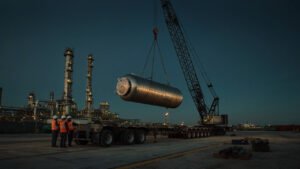
Heavy and oversized units ship as break bulk on flat rack, open top, and multipurpose vessels, and full project scopes move as coordinated project logistics. Our crews handle export packing and crating that protects the machine across two handovers and a Caspian ferry, plus the domestic heavy haul that brings the unit to the Houston terminal.
Documents and Customs
Each shipment needs a commercial invoice, a packing list, a bill of lading, and a certificate of origin, with the correct HS code on every line. The overland legs across Georgia, Azerbaijan, and into Kazakhstan move under a transit or TIR carnet from the Black Sea port to the final border. Our customs broker desk prepares the US export filing and coordinates with agents along the corridor so the cargo clears each crossing on schedule.
We build every Kazakhstan booking to route clear of Iran and Russia sanctions exposure. The Middle Corridor keeps the cargo and the parties to the transaction off those lanes, and we screen the shipment before we book so the move stays compliant from Houston to Aktau.
The same desk runs your wider regional lanes. We move freight across the Caspian to Turkmenistan, through Azerbaijan at the Baku gateway, and onward by rail to Uzbekistan. One forwarder handles every leg of the corridor.
Texas International Freight moves freight to Kazakhstan worldwide from our Houston base at 11511 Katy Fwy #320, Houston, TX 77079. Call +1 877-489-9184, email ship@txintlfreight.com, or use our contact page for a quote.
Why does cargo to Kazakhstan route through Georgia and the Caspian?
Kazakhstan has no open-ocean access, so the compliant route is the Trans-Caspian Middle Corridor. Cargo sails from Houston to a Black Sea port at Poti or Batumi in Georgia, crosses Georgia and Azerbaijan to Baku, then rides a Caspian ferry to Aktau or Kuryk and moves inland by rail or road. This keeps the shipment on a tradeable, sanctions-clear path.
How do you keep a Kazakhstan shipment clear of sanctions exposure?
We route via the Middle Corridor rather than the Iran corridor through Bandar Abbas or the Russia corridor, both of which carry sanctions exposure, and we screen every party to the transaction before booking. Kazakhstan itself is tradeable, so routine oil, gas, and mining equipment moves normally when the routing and the parties are clean.
Which Caspian port receives cargo for Kazakhstan?
Aktau and Kuryk are the two Kazakh ports on the Caspian. Cargo crosses from Baku in Azerbaijan by ferry and discharges at whichever port fits the vessel window and the inland delivery point, then moves by rail or road to the oil fields, mines, and industrial centers. We match the port to your cargo and schedule.
What cargo do you ship to Kazakhstan?
We move oil and gas gear for Tengiz, Kashagan, and Karachaganak, including pipeline valves, wellhead equipment, turbines, and transformers, plus mining equipment such as crushers, drills, and haul units for the uranium, copper, and chrome sectors. Containerized parts and out-of-gauge pieces both move.
How long does shipping from Houston to Kazakhstan take?
Plan on roughly 3 to 5 weeks for the ocean leg from the US Gulf to the Black Sea, then add the overland run across Georgia and Azerbaijan and the Caspian ferry from Baku to Aktau or Kuryk. Ferry windows and border clearance drive the total, so we build the schedule around a realistic door date.