Ocean, Caspian, and Overland Freight to Kyrgyzstan
You move mining machinery and hydropower equipment toward a landlocked mountain market with no coast and no direct sea link, and Kyrgyzstan sits behind the Central Asian ranges. Texas International Freight moves mining and heavy equipment from Houston to Kyrgyzstan via the Trans-Caspian Middle Corridor, and manages every leg from the Gulf berth to your site. How does a haul truck or a transformer reach a mine in the mountains?
How Freight Reaches Kyrgyzstan
Kyrgyzstan is landlocked with no ocean access, so your cargo travels the Middle Corridor. It sails from the US Gulf across the Atlantic and the Mediterranean to a Black Sea port at Poti or Batumi in Georgia, moves by rail and road across Georgia to Baku in Azerbaijan, and crosses the Caspian by ferry to Aktau or Kuryk in Kazakhstan. From the Caspian shore it runs by rail and road across Kazakhstan, staging through Almaty, and on to Bishkek and the mine sites inland.
We route the Middle Corridor on purpose. The Iran corridor through Bandar Abbas and the Russia corridor both carry sanctions exposure that can freeze a shipment and the parties behind it, so the Trans-Caspian route keeps your cargo clear of that risk. Plan the ocean leg to the Black Sea at roughly 3 to 5 weeks, with the Caspian crossing and the overland legs through Kazakhstan added on top.
Kyrgyzstan Cargo We Ship
Kyrgyzstan runs on gold mining, led by the Kumtor operation high in the mountains, and on hydropower along its rivers. That demand covers mining equipment such as crushers, drills, and haul units, excavators for the pits, and transformers and generators for the hydropower and grid work. We move the containerized parts and the out-of-gauge pieces that standard carriers will not book.
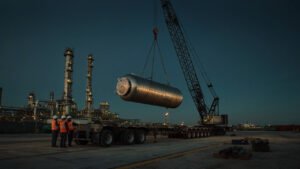
Heavy and oversized units ship as break bulk on flat rack, open top, and multipurpose vessels, and full mine or plant scopes move as coordinated project logistics. Our crews handle export packing and crating that protects the machine across multiple handovers and a Caspian ferry, plus the domestic heavy haul that brings the unit to the Houston terminal.
Documents and Customs
Each shipment needs a commercial invoice, a packing list, a bill of lading, and a certificate of origin, with the correct HS code on every line. The overland legs across Georgia, Azerbaijan, the Caspian, and Kazakhstan into Kyrgyzstan move under a transit or TIR carnet from the Black Sea port to the final border. Our customs broker desk prepares the US export filing and coordinates with agents along the corridor so the cargo clears each crossing on schedule.
We build every Kyrgyzstan booking to route clear of Iran and Russia sanctions exposure. The Middle Corridor keeps the cargo and the parties to the transaction off those lanes, and we screen the shipment before we book so the move stays compliant from Houston to Bishkek.
The same desk runs your wider regional lanes. We move freight through Kazakhstan on the way to Bishkek, and on to neighboring Uzbekistan and Tajikistan. One forwarder handles every leg of the corridor.
Texas International Freight moves freight to Kyrgyzstan worldwide from our Houston base at 11511 Katy Fwy #320, Houston, TX 77079. Call +1 877-489-9184, email ship@txintlfreight.com, or use our contact page for a quote.
Why does cargo to Kyrgyzstan route through Georgia, the Caspian, and Kazakhstan?
Kyrgyzstan is landlocked with no ocean access, so the compliant route is the Trans-Caspian Middle Corridor. Cargo sails from Houston to a Black Sea port at Poti or Batumi in Georgia, crosses to Baku, rides a Caspian ferry to Aktau or Kuryk, then runs by rail and road across Kazakhstan through Almaty to Bishkek. This keeps the shipment on a tradeable, sanctions-clear path.
How do you keep a Kyrgyzstan shipment clear of sanctions exposure?
We route via the Middle Corridor rather than the Iran corridor through Bandar Abbas or the Russia corridor, both of which carry sanctions exposure, and we screen every party to the transaction before booking. Kyrgyzstan itself is tradeable, so routine mining and hydropower equipment moves normally when the routing and the parties are clean.
What cargo do you ship to Kyrgyzstan?
We move mining equipment for the Kumtor gold operation and other mines, including crushers, drills, excavators, and haul units, plus transformers and generators for hydropower and grid work. Containerized parts and out-of-gauge pieces both move as break bulk or project cargo.
How does cargo reach a mountain mine site in Kyrgyzstan?
After the Caspian ferry lands in Kazakhstan, cargo moves by rail and road across the country, stages through Almaty near the border, and crosses to Bishkek and on to the site by heavy haul. Mountain roads and grades shape the trailer and permit plan, which we set before the unit leaves Houston.
How long does shipping from Houston to Kyrgyzstan take?
Plan on roughly 3 to 5 weeks for the ocean leg from the US Gulf to the Black Sea, then add the overland run to Baku, the Caspian ferry, and the road and rail legs through Kazakhstan to Bishkek. Ferry windows, border clearance, and mountain access drive the total, so we build the schedule around a realistic door date.