
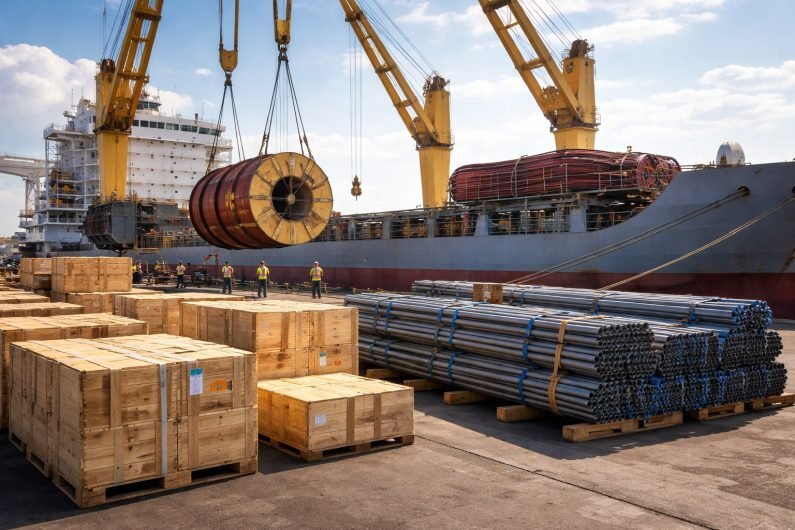
Breakbulk cargo refers to goods that are transported individually, rather than in standard shipping containers.
Each piece is handled, lifted, and secured on its own.
This transport method is essential for oversized, heavy, or non-uniform cargo that simply cannot fit inside a container.
Breakbulk is often confused with bulk cargo.
They are not the same.
Bulk cargo moves loose, such as grain or oil.
Breakbulk cargo is unitized but not containerized.
Think of it as cargo that demands custom handling at every stage of the journey.
Typical Examples of Breakbulk Cargo
Breakbulk shipping is common in industries where size and weight push logistical limits.
Common examples include:
- Heavy construction equipment
- Industrial machinery and turbines
- Steel beams, pipes, and coils
- Power generation components
- Oil and gas equipment
- Project cargo for infrastructure works
Each item requires a tailored lifting plan, proper lashing, and precise coordination at ports and terminals.
How Breakbulk Shipping Works
Breakbulk logistics rely on specialized port infrastructure and expertise.
The process usually involves:
- Cargo arriving by truck or rail at the port
- Individual lifting using cranes or gantries
- Direct loading into the vessel’s hold or onto the deck
- Custom stowage and securing
- Discharge at destination using similar equipment
Every move is planned in advance.
Errors are expensive.
Delays ripple through entire projects.
Why Breakbulk Cargo Still Matters Today
Containerization dominates global trade.
Yet breakbulk remains indispensable.
Why?
Because not everything fits in a box.
Energy projects, mining operations, and industrial expansions depend on moving single, massive components.
For these sectors, Texas ports and specialized operators play a strategic role in global supply chains.
The Role of Texas International Freight in Breakbulk Shipping
Texas International Freight supports companies moving complex breakbulk and project cargo through U.S. and international ports.
Their role extends far beyond booking space on a vessel.
Planning and engineering support
Breakbulk success starts on paper.
Texas International Freight assists with:
- Cargo surveys and dimensional analysis
- Weight distribution and lifting feasibility
- Port and vessel compatibility checks
- Load sequencing for multi-piece projects
This planning reduces handling risks before cargo ever moves.
Port and Terminal Coordination
Ports like the Port of Houston are major breakbulk hubs.
But capacity alone is not enough.
Texas International Freight coordinates:
- Terminal slot reservations
- Crane availability and lifting windows
- Stevedoring teams experienced in heavy lifts
- On-dock and off-dock storage
This coordination prevents congestion and costly dwell time.
End-To-End Project Cargo Management
Breakbulk rarely travels alone.
It is part of a larger project.
Texas International Freight manages:
- Inland trucking and heavy haul transport
- Ocean freight and charter options
- Customs documentation and compliance
- Delivery to job sites, yards, or fabrication plants
Clients benefit from a single point of control, not fragmented vendors.
Breakbulk vs Container Shipping
Understanding the distinction helps clarify why expertise matters.
Breakbulk shipping:
- Requires manual handling
- Involves higher operational risk
- Depends on skilled labor and planning
- Is essential for oversized cargo
Container shipping:
- Is standardized and automated
- Offers lower handling costs
- Works only for uniform cargo
Choosing the wrong method can delay an entire project timeline.
When to Choose Breakbulk Shipping
Breakbulk is the right solution when:
- Cargo exceeds container dimensions or weight limits
- Items cannot be dismantled
- Project deadlines demand direct vessel loading
- Cargo value justifies specialized handling
In these cases, experience matters more than price alone.
Final Thoughts
Breakbulk cargo is not a legacy shipping method.
It is a critical logistics solution for industries that build, extract, and generate.
Handled correctly, it keeps projects moving.
Handled poorly, it becomes a liability.
With its focus on planning, coordination, and execution, Texas International Freight plays a key role in helping businesses move complex cargo safely, on time, and at scale.