Freight Forwarding for Aircraft and Aviation Components
You have an airframe, an engine, or a pallet of rotables that has to reach an operator or an MRO in another country. The parts run high in value, some are export controlled, and a grounded aircraft burns money by the hour. How do you move them legally and fast? The answer splits between what flies and what sails.
What Aviation Freight Includes
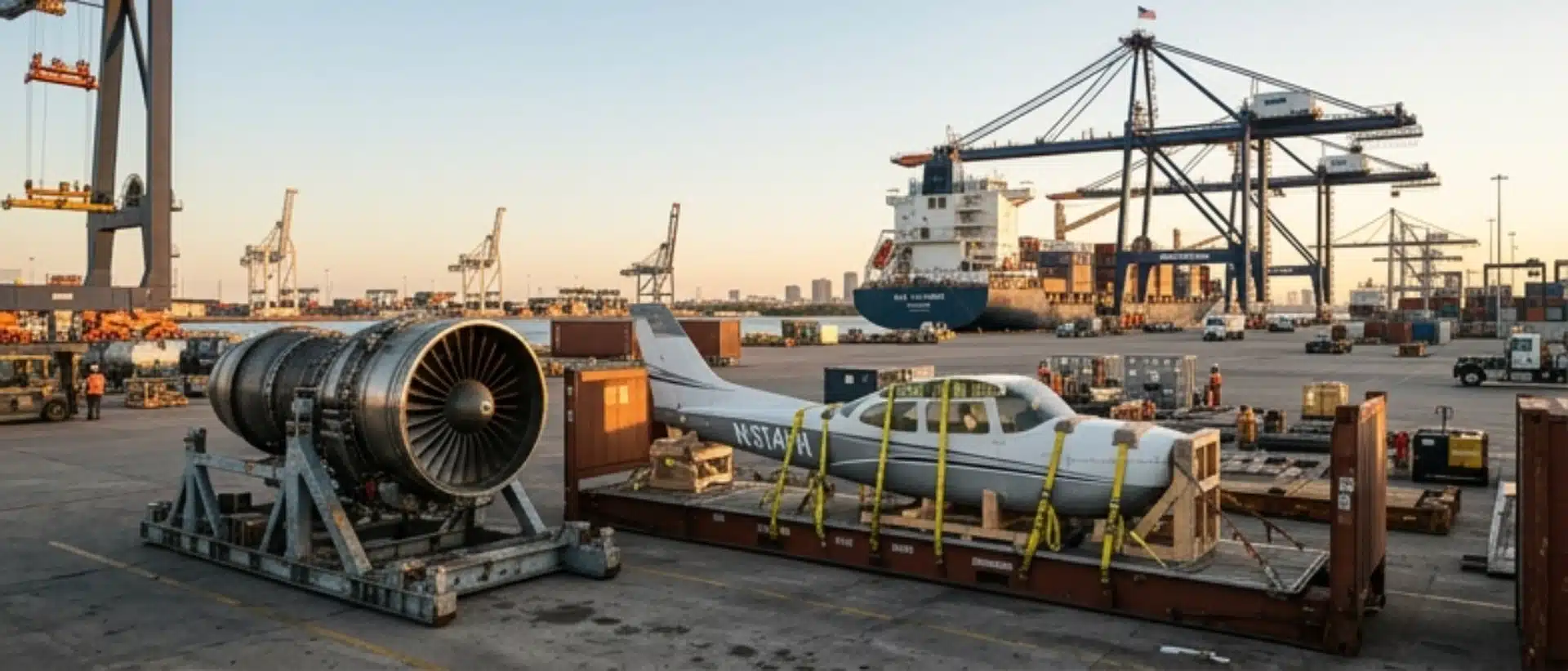
Aviation freight runs from a single turbofan engine on a stand to fuselage sections, wings, landing gear, auxiliary power units, avionics, and full rotable kits. Whole light aircraft and helicopters move too, with rotors and wings removed and crated. Each item carries high value and tight handling limits, so the packing and the paperwork matter as much as the transport.
Air Freight for AOG and High-Value Parts
An aircraft on ground waits for one part, and every hour grounded costs the operator. Air freight earns its premium here: a gearbox, an avionics unit, or a wheel assembly flies to the operator while the aircraft waits. We book the lift, prepare the dangerous goods paperwork on items such as lithium batteries and chemical oxygen generators, and hand the part to the consignee in days.
Ocean and Charter for Large Airframes
A complete airframe, a wing set, or several engines on stands ship by sea as breakbulk cargo or in crates on flat rack, and a full delivery program runs under project logistics and charter. Sea costs far less per kilo than air, so a non-urgent overhaul return or a stored airframe sails rather than flies. We plan the lift, the cradle, and the lashing for the shape.
Export Controls and Screening
Many aircraft parts fall under US export control. Defense articles sit on the US Munitions List under ITAR, run by the State Department, while most civil parts fall under the Export Administration Regulations and the Bureau of Industry and Security. We screen the commodity and the end user before booking, so a controlled engine or avionics unit ships with the right license or exemption rather than a hold.
Crating and Handling
Aviation parts demand engineered crates, shock and tilt indicators, and moisture control on sensitive avionics. Engines ride on approved shipping stands inside a frame, and fuselage sections get cradles cut to the contour. Our export packing and crating meets the marking and moisture-barrier requirements that aerospace shippers expect, so the part lands serviceable.
Helicopters and Whole Aircraft
A helicopter ships with the main and tail rotors removed, the mast protected, and the fuselage cradled in a crate or frame. We do the same work for light fixed-wing aircraft. See our dedicated helicopter shipping service, plus the wider desk that moves heavy equipment overseas and the cross-border lanes to Canada for aerospace work.
Book Your Aviation Shipment
Texas International Freight handles engines, airframes, avionics, rotables, and whole aircraft bound for operators and MROs worldwide. Send us the part, the weight and dimensions, and the destination, and we return a routing and a quote.
Contact Information:
- Phone: +1 877-489-9184
- Email: ship@txintlfreight.com
- Address: 11511 Katy Fwy #320, Houston, TX 77079
- Web Form: Request a Quote
Connect With Us:
How fast can an AOG part reach an overseas operator?
An aircraft-on-ground part moves by air and can reach a foreign operator in a few days, sometimes next flight out. The clock depends on the dangerous goods status and the export license, not the flight time. A turbine wheel or an avionics box clears faster when we screen and document it before tendering it to the airline. We book the fastest routing that the part and its paperwork allow.
Do aircraft parts need an export license?
Often, yes. Defense and military parts sit on the US Munitions List under ITAR and need State Department authorization, while civil parts fall under the Export Administration Regulations and may need a license from the Bureau of Industry and Security. We screen the part number and the end user up front. A flight-control unit for a military type and a commercial seat track are treated very differently.
How do you ship a jet engine?
A jet engine ships on its approved shipping stand inside a steel frame, with shock indicators and the inlet and exhaust covered. An urgent engine for a grounded aircraft flies as air cargo; an overhaul return or a spare with time to spare ships as ocean breakbulk on flat rack at a fraction of the cost. We match the mode to the urgency and the value.
Can you ship a whole helicopter or small aircraft?
Yes. A helicopter ships with the main and tail rotors removed, the mast protected, and the fuselage set in a cradle inside a crate or open frame. A light fixed-wing aircraft ships with the wings removed and crated alongside the fuselage. The unit can fly on a freighter for speed or sail as breakbulk for cost, and we crate it to survive either leg.
How are sensitive avionics protected in transit?
Avionics travel in engineered crates with foam cradles, desiccant, a moisture barrier, and shock and tilt indicators that show any mishandling on arrival. Static-sensitive units get anti-static wrap. The crate is marked for orientation and lift points so handlers keep it upright. The protection matches the value, since a single line-replaceable unit can run six figures.


