Freight Forwarding for Concrete Products and Precast Units
You need to move precast concrete from a US plant to a job site in another country. The pieces are heavy, the edges chip, and a single panel can outweigh a loaded container. How do you get barriers, pipe, or wall panels overseas without cracks and without paying for space you do not use? The load plan decides the outcome.
What Counts as Concrete Freight
Concrete freight covers precast wall panels, bridge beams, box culverts, pipe, traffic barriers, septic tanks, and architectural cladding. Each piece packs high weight into a small footprint, so the limit is rarely volume. The limit is axle weight on the road and deck strength at sea. A single bridge girder can run 40 tons and 100 feet, which puts it straight into heavy haul and breakbulk territory.
How Concrete Reaches the Port
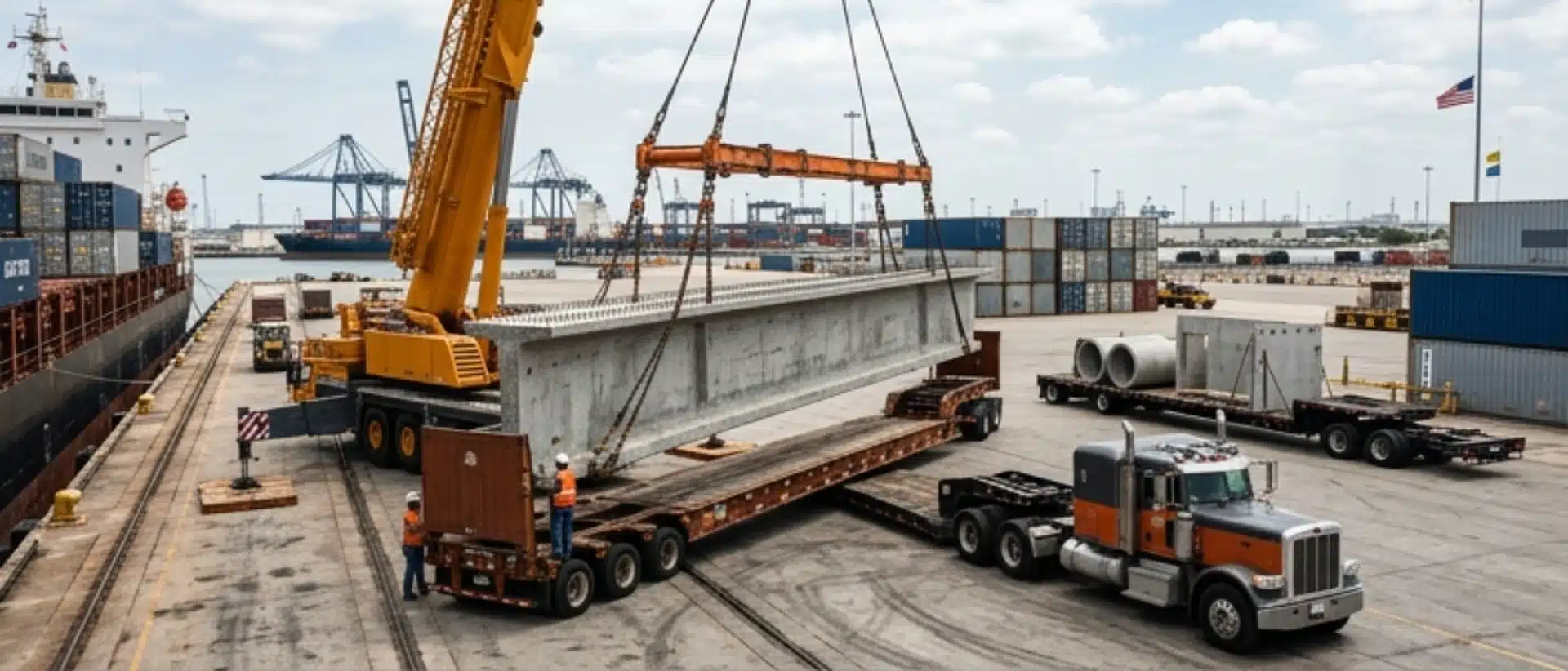
Flat panels and pipe ride on flatbed and step-deck trailers for standard loads. Oversize beams and tall culverts move on lowboy or RGN trailers, often on multi-axle configurations that spread the weight across more tires. We arrange the route survey, the state permits, and pilot cars when width or length crosses the legal line. The unit reaches Port Houston blocked, braced, and ready for the terminal crane.
Ocean Options for Heavy Concrete
Most concrete products ship as breakbulk cargo on flat rack and open-top equipment, or on the open deck of a multipurpose vessel. Dense, regular shapes such as pipe and barriers stack and lash well. For a full precast package on one schedule, vessel charter and project logistics hold the load plan, the lashing, and the discharge under one plan.
Protecting Edges and Surfaces
Concrete fails at the corners. Our crews set edge protectors, timber dunnage, and softeners under the chains so the lashing holds the piece without crushing it. Architectural and finished surfaces get film or full crating when the finish matters. Correct blocking and bracing stops the shift that cracks a panel in a seaway. See our approach to export packing and crating.
Documents and Customs
Shipments above 2,500 dollars need Electronic Export Information filed in the Automated Export System before departure, with a Schedule B number that matches the product. Your commercial invoice, packing list, and bill of lading carry accurate weights and full legal entity names. Destination duty depends on the country and any trade agreement, and our customs clearance desk keeps the paperwork ahead of the vessel.
Regional and Cross-Border Lanes
Much concrete freight stays inside North America. We run heavy haul south on the lanes to Mexico and north on the lanes to Canada, where precast moves by truck and rail to the site. One desk books the road move, the ocean leg, and the customs entry.
Book Your Concrete Shipment
Texas International Freight handles precast units, pipe, beams, and barriers bound for international and cross-border sites. Send us the dimensions, weight, and delivery point, and we return a routing and a quote.
Contact Information:
- Phone: +1 877-489-9184
- Email: ship@txintlfreight.com
- Address: 11511 Katy Fwy #320, Houston, TX 77079
- Web Form: Request a Quote
Connect With Us:
How do you ship a precast bridge beam overseas?
A bridge beam ships as breakbulk on flat rack or on the open deck of a multipurpose vessel. The beam first moves to Port Houston on a multi-axle lowboy under a route survey and state permits, with pilot cars for the long load. At the terminal it is lifted, set on dunnage, and lashed against shift. A 90-foot, 45-ton girder bound for a Caribbean crossing rides this way rather than in any container.
Is it cheaper to ship concrete by sea or by air?
Sea, by a wide margin. Concrete carries high weight for low value, and air freight prices on weight, so flying it rarely makes sense. Ocean breakbulk and flat rack move barriers, pipe, and panels at the lowest cost per ton. Air only fits a small, urgent fixing or fastener kit that holds up an install, not the concrete itself.
How do you stop precast panels from cracking in transit?
Edge protectors, timber dunnage, and chain softeners spread the load so the lashing grips the panel without crushing a corner. The panels are blocked and braced so they cannot slide or rack when the vessel rolls. Finished architectural panels get film or crating to guard the face. The support and securing decide if the panel survives the trip intact.
Do concrete products need export crating?
It depends on the surface. Raw pipe, culverts, and standard barriers travel uncrated on flat rack with dunnage and lashing. Architectural cladding and finished panels get crates or film because a scuff on the visible face is a reject on site. We match the packing to the product so you pay for protection only where it earns its place.
Can you ship a full precast building package?
Yes. A precast building or modular package with many panels, beams, and connections moves best under vessel charter and project logistics, so the whole set lands on one schedule. We plan the load sequence, the lashing, and the discharge, then coordinate the inland delivery to the site. One team runs the move from the Texas plant to the foreign job site.


