Freight Forwarding for Granite, Marble, and Quartz Slabs
You are moving a container of granite, marble, or engineered quartz from a US distributor to a fabricator overseas. The slabs are heavy, the edges chip, and a cracked slab is a total loss. How do you load dense stone so it travels without breaking and without blowing past the container’s weight limit? Racking and bracing decide it.
What Stone Slab Freight Covers
This freight covers natural stone such as granite, marble, and quartzite, plus engineered quartz surfaces sold under brand names. Slabs run large and heavy, a single granite slab can weigh several hundred pounds, and they break at the edges and corners. The weight comes fast, so a container reaches its payload limit long before it looks full. Stone is a weight problem, not a space problem.
A-Frames, Bundles, and Crates
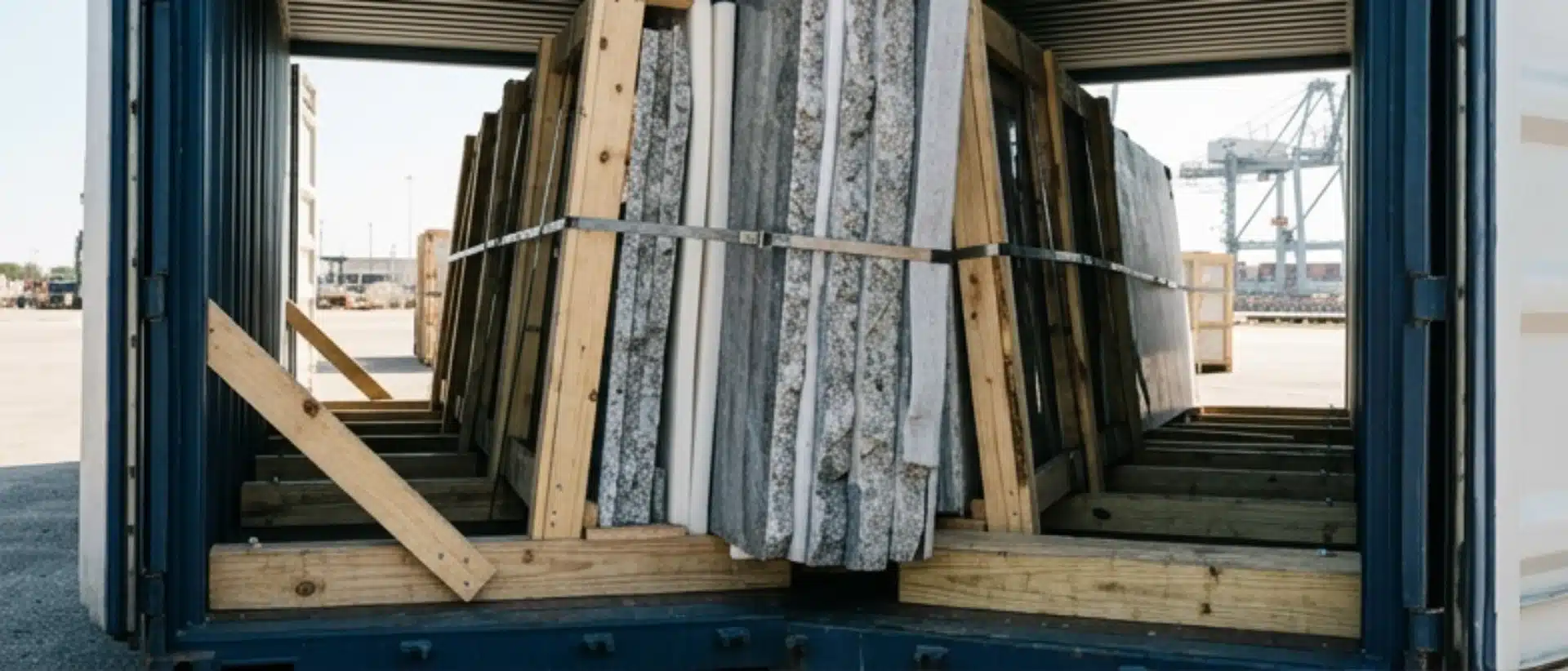
Slabs ship standing on A-frame racks or banded into bundles, with foam or cardboard interleaving between faces so they do not rub or chip. High-value or finished slabs go into wooden crates built to the slab size. Our export packing and crating sets the racks and the dunnage so the load sits tight and the faces stay protected through handling and the sea passage.
Loading Slabs in a Container
Stone loads against the container’s weight rating, not its volume. A standard container caps near its payload limit with only part of the floor used, so we plan the weight over the axles and keep the load legal for the road leg. The A-frames are blocked and braced to the walls so the stone cannot tip or slide. Even loading keeps the box within road limits at both ends.
Breakbulk for Large Volumes
A large stone order or oversized blocks can move as breakbulk cargo rather than in boxes, on regular ocean freight service. Quarry blocks bound for a slab plant ship this way. We arrange the lift, the dunnage, and the lashing for the weight and shape, then coordinate the discharge at the destination port.
Documents, Customs, and Duty
A stone shipment above 2,500 dollars needs Electronic Export Information filed in the Automated Export System with a Schedule B number for the stone type, since natural and engineered stone classify differently. The commercial invoice, packing list, and bill of lading carry accurate weights and full legal entity names. Our customs clearance desk keeps the entry ready so the slabs clear without demurrage.
Cross-Border and Regional Lanes
Plenty of stone moves across North America. We run the lanes south to Mexico and north to Canada, where fabricators take container loads by truck and rail. One desk books the road move, the ocean leg, and the customs entry, so your stone arrives whole and on time.
Book Your Stone Shipment
Texas International Freight ships granite, marble, quartzite, and engineered quartz slabs to fabricators and distributors worldwide. Send us the slab count, weight, and destination, and we return a routing and a quote.
Contact Information:
- Phone: +1 877-489-9184
- Email: ship@txintlfreight.com
- Address: 11511 Katy Fwy #320, Houston, TX 77079
- Web Form: Request a Quote
Connect With Us:
How are stone slabs packed for ocean shipping?
Slabs travel standing on steel or wooden A-frame racks, or banded into bundles, with foam or cardboard between the faces so they do not rub or chip. The racks are blocked and braced inside the container so the stone cannot shift. Finished or high-value slabs go into purpose-built crates. The packing keeps the slabs upright and supported, which is how dense stone survives a sea passage.
How many slabs fit in a container?
Weight decides, not space. Stone is so dense that a container hits its payload limit, often around 20 to 24 tons of cargo, with the floor only partly used. A bundle of granite slabs can reach that ceiling quickly. We load to the weight rating and balance it over the axles so the box stays legal on the road at both ends, rather than filling the volume.
How do you stop slabs from cracking in transit?
Support and bracing. Slabs sit upright on A-frames so the load runs through the strong axis, with interleaving to stop face-to-face rub and edge protection on the corners. The racks are braced to the container walls so nothing tips or slides when the vessel rolls. A slab that is laid flat or left loose is the one that cracks, so we keep it standing and tight.
Is there a shipping difference between granite and engineered quartz?
Both are heavy and both break at the edges, so the handling is much the same: upright on racks, interleaved, braced, and loaded to weight. Engineered quartz slabs are uniform in size, which makes them stack and rack cleanly, while natural granite and marble vary, so the racking adapts to the lot. The customs classification differs between natural and engineered stone, and we file each correctly.
Do stone slabs need crating, or can they ship on racks?
Most slabs ship on A-frame racks or in bundles inside a container, which is enough for sound, braced stone. Crates come in for finished, polished, or high-value slabs where a single chip is a costly reject, and for slabs that travel as breakbulk rather than in a box. We match the packing to the value, so you pay for crating only where it protects real money.


