Reliable Freight Forwarding to Japan From Houston
You need to move heavy machinery, oil and gas equipment, or breakbulk cargo from Houston to Japan, one of the world’s largest importers of industrial goods. Which Japanese port fits your cargo, what does customs require, and how long is the Pacific crossing? Get the port and the paperwork right and the move stays predictable.
Japan’s construction, mining, manufacturing, and energy sectors depend on imported equipment, and Texas International Freight moves it from the Gulf Coast by ocean and air. We handle the booking, the export filing, customs coordination, and inland delivery as one job, so your cargo reaches Yokohama, Osaka, or Nagoya on schedule.
What Ships to Japan
Demand spans several industries:
- Oil and gas: drilling rigs, compressors, blowout preventers, and rotary tables for the energy sector.
- Mining: excavators, conveyors, and crushing machines for resource extraction and processing.
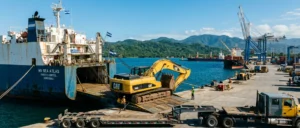
- Construction: backhoes, cranes, bulldozers, and aerial work platforms, delivered on schedule to keep projects moving.
- Renewable energy: wind turbines, nacelles, and geothermal drilling rigs as Japan expands its clean-energy capacity.
Japan’s Main Ports
The port follows the cargo and the delivery region. Yokohama, Japan’s busiest container port, is the preferred hub for the Greater Tokyo area and a wide range of industrial cargo. Osaka, in western Japan, supports the manufacturing base of the Kansai region. Nagoya handles the country’s largest share of industrial and automotive machinery, with facilities built for large units. Kobe and Tokyo add capacity when a project routes through them. A line of mining equipment for a Kansai site clears at Osaka, while machinery for the capital region lands at Yokohama.
How Your Cargo Reaches Japan
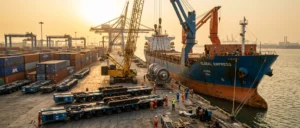
Most heavy and oversized cargo moves by ocean freight, the most cost-effective option for machinery, raw materials, and out-of-gauge units. We arrange Full Container Load and Less than Container Load service, along with breakbulk and bulk cargo for drill pipes, compressors, and heat exchangers. Plan on roughly three to five weeks of sailing time from the Gulf Coast across the Pacific, depending on routing and transshipment. Air freight moves urgent or high-value parts in days, and for oversized project moves our project logistics team plans routing and crane work for loading and discharge.
Customs, Consumption Tax, and METI
Japan has detailed import procedures, and accurate documentation keeps clearance moving. Cargo clears through Japan Customs, a 10 percent consumption tax applies on the import value alongside any duties, and certain controlled goods, including some energy and technology equipment, fall under the Ministry of Economy, Trade and Industry (METI) and its import and export controls. We prepare the export and commercial documentation and coordinate with a customs broker in Japan to keep entry inspections on track.
Packaging and Cargo Security
Packaging protects the equipment and the schedule. Our crews handle export packing, including blocking, bracing, and crating, built to protect heavy and fragile units against impact, moisture, and shifting in transit. For high-value goods, cargo insurance covers accidental damage, theft, and general average exposure on the ocean leg.
Working With Texas International Freight
Texas International Freight books vessel and aircraft space, prepares your export filing, coordinates Japanese customs, and arranges door-to-door delivery through local partners. The same desk runs the wider Asia region, with lanes to South Korea, China, and Vietnam, so a multi-market move sits with one team. Tell us the cargo and the destination, and we map the move.
Ship Your Equipment to Japan
Texas International Freight moves heavy machinery, oil and gas equipment, and breakbulk cargo from Houston to Japan, with export filing, customs coordination, packing, and delivery handled in house. Send us the equipment, dimensions, and delivery point, and we return a plan and a quote.
Contact Information:
- Phone: +1 877-489-9184
- Email: ship@txintlfreight.com
- Address: 11511 Katy Fwy #320, Houston, TX 77079
- Web Form: Request a Quote
Connect With Us:
What is the best shipping option for heavy machinery to Japan?
Ocean freight is usually the most economical choice for oversized equipment such as excavators, wind turbines, and industrial machinery, since it handles large volumes and weight at a lower cost per ton than air freight.
How long does shipping from Houston to Japan take?
Ocean transit across the Pacific runs roughly three to five weeks depending on routing and transshipment. Air freight delivers urgent cargo in about five to seven days, subject to scheduling and customs clearance.
Can you handle customs clearance in Japan?
Yes. We prepare the export filings and coordinate with experienced customs brokers in Japan to manage import documentation, the consumption tax, any METI controls, and entry inspections for a clean clearance.
What insurance do you offer for international shipping?
We provide cargo insurance that covers accidental damage, theft, and general average exposure, and we help you match the coverage to your cargo’s value and the shipping route.
Do you ship to Japan’s neighboring countries?
Yes. We run lanes across Asia, including South Korea, China, and Vietnam, so we can support a project that spans more than one market in the region on one plan.