What Shipping to Brazil From the US Involves
Shipping to Brazil from the US moves equipment for mining, agriculture, oil and gas, and construction into one of the largest markets in the Americas. The route runs by ocean or air, and Brazilian customs sets clear rules you meet before your cargo sails. Here is how the process works and how to pick the right option.
What to Know Before Shipping to Brazil
Brazil runs a detailed import system, so preparation matters. You register as an importer, classify your goods, agree the Incoterm that sets where cost and risk pass to the Brazilian buyer, and budget for federal and state taxes before anything ships.
Import control runs through the Portal Unico de Comercio Exterior, Brazil’s integrated foreign trade platform that has replaced the legacy Siscomex screens. Most commercial importers need a RADAR license from Receita Federal, the federal revenue service, to clear goods. As of 2026, import entries file on the DUIMP (Declaracao Unica de Importacao), which has superseded the older DI import declaration.
Your cargo also needs an NCM code, the eight-digit Mercosur tariff classification that sets the duty rate. Get this right and you avoid reclassification delays at the port.
Taxes and Duties on Brazilian Imports
Brazil layers several taxes on imported equipment. Budget for the Import Tax (II), the IPI industrial products tax, state ICMS, and PIS and COFINS contributions. Under the tax reform in Constitutional Amendment 132/2023, 2026 is a transition year: the new CBS and IBS value-added taxes run at token test rates while PIS, COFINS, ICMS, and IPI phase out through 2033, so confirm the current treatment for your NCM before you budget.
Rates depend on the NCM classification and the destination state. A local customs broker, the despachante aduaneiro, calculates the full landed cost so the final bill holds no surprises.
Documents You Need to Ship to Brazil
Accurate paperwork keeps your shipment moving. For most freight to Brazil you prepare:
✔ Commercial invoice with the value and full description of the goods
✔ Packing list detailing weights, dimensions, and contents
✔ Bill of lading for ocean freight, or an air waybill for air cargo
✔ Certificate of Origin stating where the goods were manufactured
✔ Import declaration filed on the DUIMP through the Portal Unico by your broker
Every document must match. A mismatch between the invoice, packing list, and bill of lading is one of the most common reasons cargo sits in customs.
Freight Options for Shipping to Brazil
Two modes move freight from the US to Brazil: ocean and air.
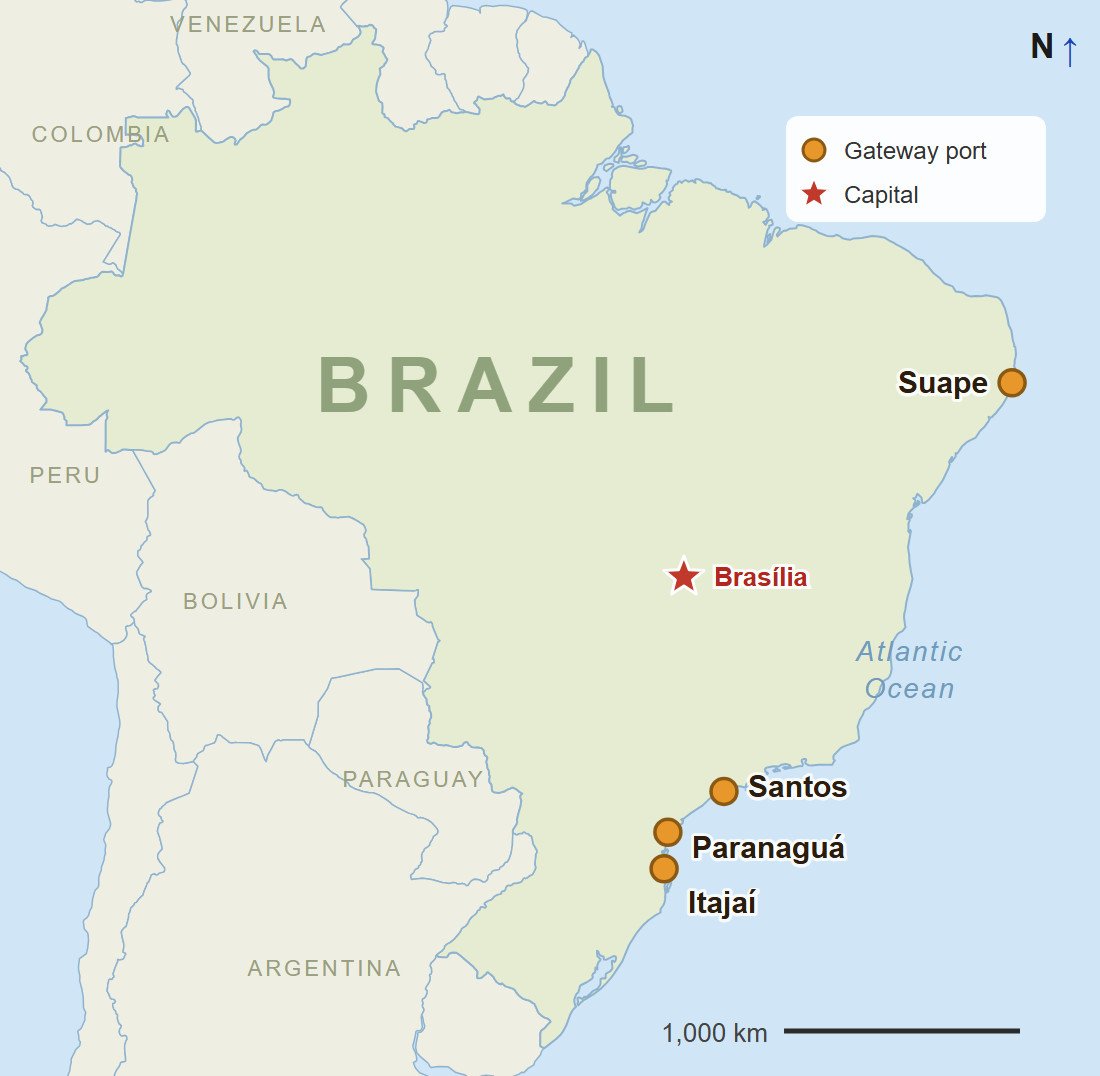
Ocean freight carries the bulk of US-Brazil trade and suits heavy and oversized cargo. You ship a full container (FCL), share one (LCL), or move out-of-gauge machinery as breakbulk or on Ro-Ro vessels. Major gateways include the Port of Santos, Paranagua, Itajai, and Suape.
Air freight moves faster for urgent or high-value parts, at a higher cost. It fits spares, instruments, and time-critical components rather than full machines.
For excavators, cranes, drilling equipment, and harvesters, ocean freight is almost always the practical choice.
How to Choose a Freight Forwarder for Brazil
A freight forwarder arranges and manages the shipment end to end, from booking to customs to final delivery.
Pick one with real Brazil experience, a working relationship with local customs brokers, and a record on heavy and project cargo. Confirm they handle DUIMP filings on the Portal Unico, coordinate inland transport from the port, and carry proper cargo insurance.
Texas International Freight moves freight to Brazil from Houston and the Port of Houston for the mining, agriculture, energy, and construction sectors, and coordinates other South American lanes such as shipping to Argentina and Chile.
Match the Shipping Option to Your Cargo
The right mode depends on size, weight, urgency, and budget. Ocean freight wins on cost and capacity for heavy equipment. Air freight wins on speed for smaller, urgent loads.
Tell your forwarder the dimensions, weight, and deadline, and they route the most efficient option for your cargo.
Get Your Brazil Shipment Booked
Ready to ship to Brazil? Texas International Freight brings years of experience moving heavy equipment into Brazilian ports and clearing it through customs. Send us the dimensions, weight, and delivery point, and we return a routing and a quote.
Phone: +1 877-489-9184
Email: ship@txintlfreight.com
Address: 11511 Katy Fwy #320, Houston, TX 77079
Explore our related services:
Breakbulk · Container Shipping · Air Freight · Vessel Charter
Frequently Asked Questions
We cover the wider South American coast as well, including project cargo to Suriname on the Guiana Shield.
What are the main ways to ship from the US to Brazil?
Ocean freight and air freight. Ocean handles the bulk of heavy and oversized cargo through ports like Santos and Paranagua, while air freight suits urgent, high-value parts. There is no road route between the US and Brazil.
Do I need a license to import into Brazil?
Most commercial importers need a RADAR license from Receita Federal to clear goods through the Portal Unico. Your customs broker can guide the registration.
What is an NCM code?
The NCM is the eight-digit Mercosur tariff classification, based on the Harmonized System, that sets the duty rate on your goods in Brazil.
Which taxes apply to imports into Brazil?
Imports can carry the Import Tax (II), the IPI industrial products tax, state ICMS, and PIS and COFINS contributions. The total depends on the NCM code and the destination state.
What documents do I need to ship to Brazil?
A commercial invoice, packing list, bill of lading or air waybill, certificate of origin, and an import declaration filed on the DUIMP through the Portal Unico. Consistent details across every document prevent customs delays.
Shipping to Other Latin American Markets
Texas International Freight moves heavy equipment and project cargo across Latin America. See our other destination guides:
- Shipping to Argentina
- Shipping to Belize
- Shipping to Chile
- Shipping to Colombia
- Shipping to Costa Rica
- Shipping to the Dominican Republic
- Shipping to Ecuador
- Shipping to Guatemala
- Shipping to Guyana
- Shipping to Honduras
- Shipping to Mexico
- Shipping to Panama
- Shipping to Peru
- Shipping to Suriname
- Shipping to Uruguay