Ocean and Air Freight to Tunisia from Houston and the Gulf Coast
You need to move machinery, industrial equipment, or breakbulk cargo from Texas to Tunisia. Where does it land, what duty applies, and how do you keep freight moving through the Mediterranean ports? The answers shape your timeline and your budget.
Texas International Freight books export shipments from Houston to Rades, Sfax, and Bizerte. Our team arranges ocean and air capacity, prepares export filings, and coordinates inland delivery to your Tunisian site. We handle the heavy and oversized cargo standard parcel carriers cannot move.
Rades, Sfax, and the Tunisian Ports
Rades, near Tunis, is the main container and roll-on roll-off port and handles most of Tunisia’s general cargo. It runs busy, so booking and clearance reward planning. Sfax in the south serves phosphates and general cargo, while Bizerte and Menzel Bourguiba in the north take bulk and oil traffic. Gabes handles chemical and industrial cargo, and Zarzis in the south anchors a free zone with oil and gas activity.
Manufacturing, automotive components, phosphates, textiles, and energy anchor the economy, which keeps demand steady for imported machinery and production equipment. Which port sits closest to your delivery point?
How Your Equipment Reaches Tunisia
Cargo leaving Houston crosses the Atlantic, passes the Strait of Gibraltar, and enters the Mediterranean to reach Rades. The route never touches the Red Sea or the Bab el-Mandeb Strait, so the disruption that rerouted Asian-origin cargo around Africa does not apply to your US Gulf sailings.
Plan on roughly three to four weeks of ocean freight from the Gulf Coast, depending on a direct service or transshipment through a Mediterranean hub such as Algeciras, Malta, or Genoa. Breakbulk moves on a multipurpose or chartered vessel can run longer because of load and discharge windows.
Duties, VAT, and Tunisian Customs
Tunisia has an association agreement with the European Union but no free trade agreement with the United States, so US-origin goods enter under most-favored-nation tariff rates that vary by Harmonized System code, plus 19 percent VAT on the import value. Some capital equipment and goods for the offshore and free-zone regimes carry relief.
Customs values cargo on the CIF basis and clears through an electronic system. Your consignee needs the document set in order before arrival, and our destination partners keep your customs clearance moving so the cargo does not sit at the port.
Export Paperwork on the US Side
Shipments valued above 2,500 dollars or carrying a license requirement need Electronic Export Information filed in the Automated Export System before departure, under the right Schedule B classification. Energy and technology equipment can fall under Bureau of Industry and Security export controls, so screening happens before booking.
Your document set covers the commercial invoice, the packing list, the bill of lading or air waybill, and any certificate the commodity requires. Proper export packing and crating protects the machine and satisfies marking rules.
Moving Oversized and Heavy Cargo
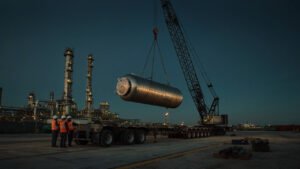
Equipment that exceeds container dimensions ships as breakbulk cargo, on flat rack and open-top units, by roll-on roll-off, or on a chartered vessel for a full project. Generators, transformers, and production lines travel this way. Self-propelled units often roll on and roll off under their own power.
Industrial, energy, and infrastructure projects rarely move one piece at a time. For a multi-unit move, project logistics and vessel charter keep the whole shipment on one plan. The same desk arranges heavy equipment shipped overseas and the domestic heavy haul to the Houston terminal.
Working With a Houston Freight Forwarder
Texas International Freight books vessel and aircraft space, prepares your AES filing and commercial documents, coordinates with Tunisian customs agents, and arranges inland trucking from Rades or Sfax to your site. You work with one team from pickup in Texas to delivery in Tunisia.
The same desk runs your wider North Africa lanes. We move freight to Algeria, Libya, Morocco, and Egypt, route cargo through the wider Middle East, and cover the region from our shipping to Africa desk. We also keep your North American freight moving on the trucking lanes to Mexico and the heavy equipment lanes to Canada. One forwarder, one point of contact, every leg of the move.
Get Your Tunisia Shipment Booked
Texas International Freight handles machinery, industrial equipment, breakbulk cargo, and oversized freight bound for Tunisia. Send us the dimensions, weight, and delivery point, and we return a routing and a quote.
Contact Information:
- Phone: +1 877-489-9184
- Email: ship@txintlfreight.com
- Address: 11511 Katy Fwy #320, Houston, TX 77079
- Web Form: Request a Quote
Which Tunisian port should you ship to?
Rades, near Tunis, is the main container and roll-on roll-off port and handles most of Tunisia’s general cargo, though it runs busy, so booking and clearance reward planning. Sfax in the south serves phosphates and general cargo, Bizerte and Menzel Bourguiba in the north take bulk and oil traffic, and Gabes handles chemical and industrial cargo. Zarzis in the south anchors a free zone with oil and gas activity. Match the port to your delivery point and the commodity.
Do US-origin goods pay import duty in Tunisia?
Tunisia has an association agreement with the European Union but no free trade agreement with the United States, so US-origin goods enter under most-favored-nation tariff rates that vary by Harmonized System code, plus 19 percent VAT on the import value. Some capital equipment and goods for the offshore and free-zone regimes carry relief. Customs values cargo on the CIF basis and clears through an electronic system, so the document set has to match before arrival.
How long does ocean freight from Houston to Tunisia take?
Plan on roughly three to four weeks of sailing time from the Gulf Coast to Rades, depending on a direct service or transshipment through a Mediterranean hub such as Algeciras, Malta, or Genoa. Cargo crosses the Atlantic, passes the Strait of Gibraltar, and enters the Mediterranean, so the route never touches the Red Sea. Breakbulk and project cargo on a chartered or multipurpose vessel can run longer because of load and discharge windows. Air freight to Tunis moves urgent parts in a few days.
Can you ship industrial and project equipment to Tunisia?
Yes. Tunisia’s manufacturing, automotive components, phosphate, and energy sectors draw steady demand for machinery, generators, and process equipment, which moves containerized or as breakbulk. Free-zone and offshore manufacturing also import production lines and tooling. We consolidate, book, file the export paperwork, and coordinate destination clearance so the cargo lands ready for delivery to your Tunisian site.
How do you ship an oversized item that will not fit in a container?
Oversized cargo moves as breakbulk, on flat rack and open-top equipment, by roll-on roll-off, or on a chartered multipurpose vessel for full project moves. A generator, a transformer, or a self-propelled machine ships on breakbulk berths rather than in a standard box. Our team handles export crating, blocking and bracing, and lashing so the unit arrives intact. For an industrial, energy, or infrastructure project with several heavy pieces, vessel charter and project logistics keep the whole move on one plan.