Europe’s Busiest Ports for Heavy and Project Cargo
If you ship heavy equipment or project cargo into Europe, the port of entry shapes your route, your cost, and your inland haul. Which European ports move the most cargo, what is each one good at, and where should your machinery land? Here are the busiest, ranked by 2024 tonnage, and how Texas International Freight moves oversized cargo through them.
Port of Rotterdam, Netherlands
Rotterdam is the largest port in Europe, handling 435.8 million tons of cargo in 2024. It connects deep into Germany, Belgium, and France by river, road, and rail, and specializes in oil, petroleum, chemicals, iron ore, coal, and agricultural products. Deep-water berths and heavy-lift cranes make it a primary gateway for industrial equipment, and our heavy equipment shipping moves project cargo through it into the Netherlands and beyond.
Port of Antwerp-Bruges, Belgium
Antwerp-Bruges handled 277.7 million tons in 2024, combining Antwerp’s inland breakbulk, container, and chemical strength with Zeebrugge’s roll-on roll-off, LNG, and container traffic. That range makes it one of Europe’s key ports for automotive, steel, and chemical cargo, and it pairs well with our breakbulk shipping into Belgium.
Port of Hamburg, Germany
Hamburg, Germany’s largest port, moved 111.8 million tons in 2024. It handles container traffic, bulk, and project cargo, and its heavy-lift cranes take oversized machinery. Our ocean freight service supports companies shipping industrial components into Germany and central Europe.
Port of Algeciras, Spain
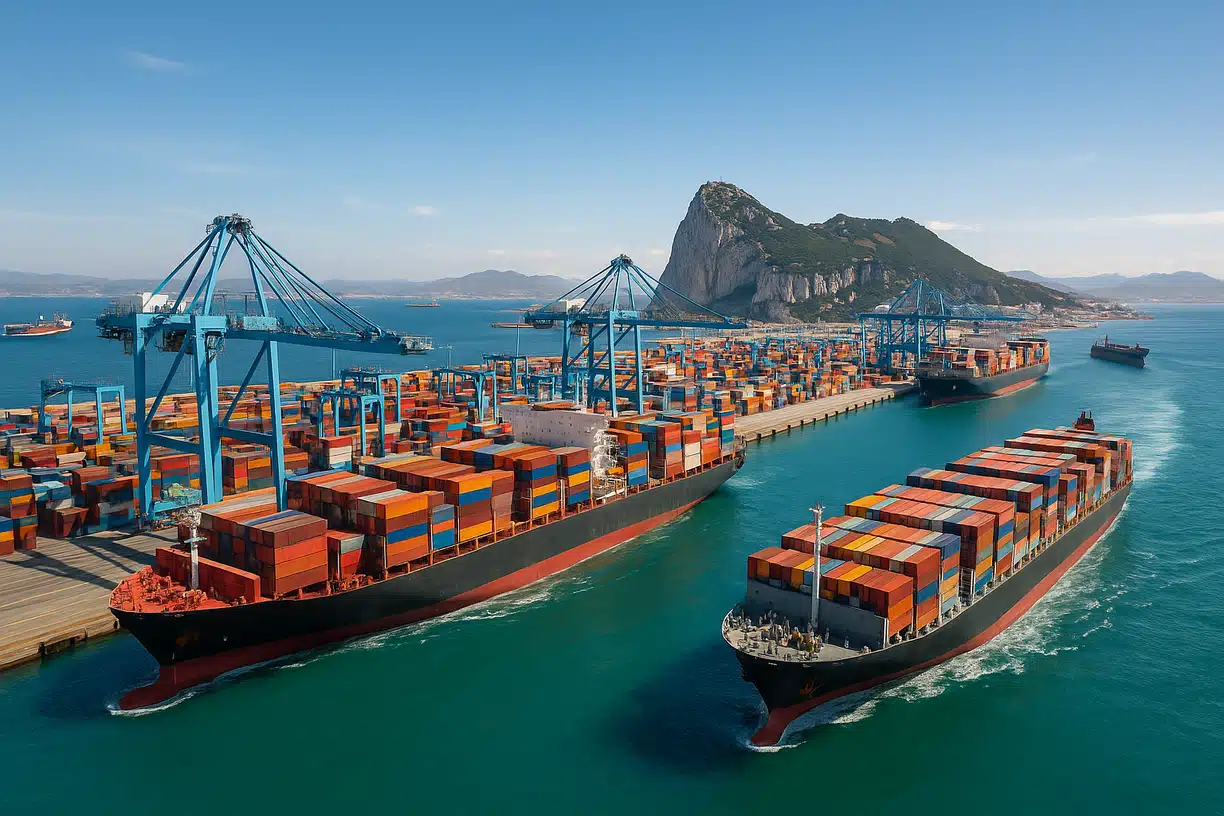
At the Strait of Gibraltar, Algeciras handled 103.6 million tons in 2024. Its position at the crossroads of Europe, Africa, and the Americas makes it a major container transshipment hub, with facilities for bulk cargo and roll-on roll-off. We route heavy cargo through it when a Mediterranean entry fits the project.
HAROPA Port: Le Havre, Rouen, and Paris, France
The HAROPA network moved 83.2 million tons in 2024 across Le Havre’s deep-sea container and petroleum terminals, Rouen’s agricultural and bulk berths, and Paris’s inland distribution along the Seine. The river-sea model suits multimodal oversized cargo, and we use those river connections to reach inland France.
Port of Valencia, Spain
Valencia recorded 81.1 million tons in 2024, Spain’s top container port. It handles container, roll-on roll-off, bulk, and general cargo, with facilities for oversized shipments and strong connections to its hinterland. We arrange customs clearance and inland transport for heavy shipments moving through it.
Port of Constanța, Romania
Constanța is the largest Black Sea port, handling 77.5 million tons in 2024. Its link to central Europe through the Danube-Black Sea Canal, along with crude oil, coal, grain, and container traffic, makes it a key entry point for eastern Europe and a route for oversized project cargo moving inland.
Port of Gdańsk, Poland
Gdańsk, Poland’s largest port, processed 77.4 million tons in 2024. Deep-water terminals take mega container ships, and the port handles containers, fuels, coal, and general cargo with steady investment behind it. We move heavy equipment through it into central Europe.
Novorossiysk and Ust-Luga, Russia
By tonnage, two Russian ports rank among Europe’s largest: Novorossiysk on the Black Sea at 164.8 million tons in 2024, focused on oil, grain, fertilizers, and timber, and Ust-Luga on the Baltic at 135.0 million tons, handling coal, fertilizers, containers, and roll-on roll-off. Current US and EU sanctions heavily restrict shipments to Russia, so we do not route cargo to these ports, and we screen every booking for compliance before it moves.
Why Specialized Freight Services Matter
Moving oversized shipments through these ports takes more than standard forwarding. The work spans route planning and feasibility studies, specialized equipment for oversized transport, permitting and compliance, customs clearance at the European port, project management for complex cargo, and risk assessment and insurance. That depth is what makes Texas International Freight a reliable partner for oil and gas, construction, energy, and manufacturing.
Ship Heavy Cargo to Europe
Texas International Freight moves heavy machinery, industrial components, and oversized project cargo from the U.S. Gulf to Europe’s busiest ports, with permits, customs, heavy haulage, and cranage handled end to end. Send us the cargo, the origin, and the European delivery point, and we return a plan and a quote.
Contact Information:
- Phone: +1 877-489-9184
- Email: ship@txintlfreight.com
- Address: 11511 Katy Fwy #320, Houston, TX 77079
- Web Form: Request a Quote
Connect With Us:
What counts as heavy or oversized cargo?
Heavy or oversized cargo exceeds standard container dimensions or road weight limits. Examples include turbines, presses, generators, excavators, and large structural modules. We evaluate weight, dimensions, center of gravity, and lift points to set the right transport method, starting with our heavy equipment shipping.
Which European ports are best for heavy-lift operations?
Rotterdam, Hamburg, Antwerp-Bruges, and Valencia offer deep-water berths and heavy-lift crane capacity. Project cargo can also route through Algeciras, HAROPA, Gdańsk, and Constanța depending on origin, timeline, and budget. We design the route through our project logistics desk.
Do I need permits and escorts for oversized road moves in Europe?
Usually, yes. Most countries require oversize permits, escort vehicles, and time-of-day restrictions, and bridge capacities, axle loads, and local police approvals may apply. We obtain the permits and coordinate escorts as part of oversized freight shipping.
How long does it take to ship heavy machinery to Europe?
Transit time depends on origin, port congestion, sailing frequency, and inland approvals. Ocean legs from the U.S. Gulf to northern Europe typically run about two to three weeks, before pre-carriage, customs, and last-mile delivery. Ask about our ocean freight options for time-sensitive moves.
Can you provide door-to-door delivery from factory to site?
Yes. We handle factory pickup, export formalities, the ocean leg, port handling, permits, heavy haulage, cranage, and site delivery. Where it helps, we use river barge or rail for safer, lower-emission inland moves, all under our project logistics service.