Aerospace Freight Forwarding from Houston and the Gulf Coast
You move aircraft engines, satellite systems, or oversized airframe sections, and every shipment carries tight deadlines and strict compliance rules. Where does the cargo route, what export controls apply, and how do you keep a high-value component intact from the factory floor to the destination hangar?
Texas International Freight books air and ocean freight for the aerospace sector from Houston to manufacturing centers, maintenance bases, and launch programs worldwide. You work with one team that prepares the export filing, screens the commodity, arranges the right equipment, and tracks the unit to delivery. We move the heavy, delicate, and controlled cargo that standard parcel carriers will not touch.
What You Ship With Us
Aerospace cargo runs from a single avionics box to a complete propulsion system. We handle the full range:
- Aircraft engines and components
Turbine blades, gearboxes, landing gear, and complete propulsion units, crated and braced for transit. - Satellite systems
Climate-controlled containers protect sensitive electronics and payloads through every temperature swing. - Space program hardware
Launch vehicle sections and test articles ship on custom rigging built around the piece. - Ground support equipment
Tugs, loaders, and test rigs reach airlines and defense bases ready to run.
ITAR, EAR, and Export Controls
Aerospace freight lives under export rules that other cargo skips. Defense articles fall under the International Traffic in Arms Regulations, and dual-use technology falls under the Export Administration Regulations. Get the classification wrong and the shipment stops at the border.
Your cargo gets a Schedule B classification that matches the commodity, plus Electronic Export Information filed in the Automated Export System before departure on any move above the reporting threshold or carrying a license requirement. A defense contractor sending controlled avionics to an allied air force needs screening and, in many cases, a license from the Directorate of Defense Trade Controls or the Bureau of Industry and Security. We run that check before booking, not after the truck arrives. Our customs clearance desk keeps the paperwork aligned on both ends.
Air or Ocean Freight for Aerospace Cargo
Speed and weight decide the mode. Air freight to a grounded fleet earns its premium when a missing part costs an airline thousands of dollars an hour. A spare engine flies to the maintenance base while the rest of the order sails. Ocean freight carries the weight and the bulk at the lowest cost per ton, so it fits ground support rigs, structural assemblies, and full project shipments.
Many aerospace moves use both modes at once. A turbine engine on an urgent air booking, a set of tooling and fixtures on an ocean container, all on one coordinated plan and one point of contact.
Oversized and Heavy Aerospace Components
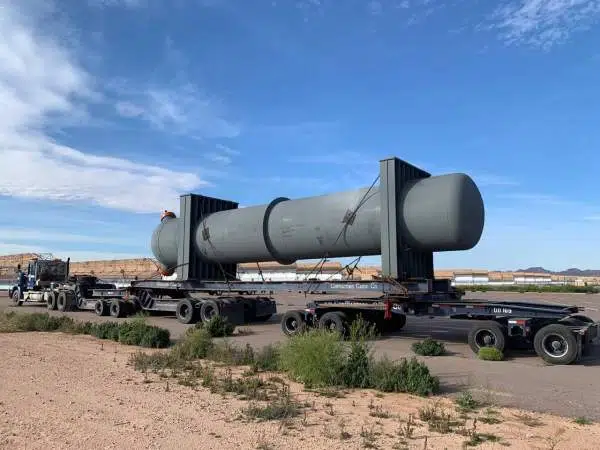
Some pieces never fit in a standard box. A wing assembly, a fuselage section, or a large satellite container moves as breakbulk cargo, on flat rack and open-top units, or on a chartered vessel for a full program. Our crews handle blocking, bracing, and lashing so the unit arrives intact, and export packing and crating meets the marking rules at destination.
For a multi-unit move, project logistics keeps the whole shipment on one schedule. The same desk arranges heavy equipment shipped overseas and the domestic heavy haul that brings the piece to the Houston terminal.
Why Houston and Texas Anchor Aerospace Freight
Texas gives your cargo a head start. The state ranks third in the nation for aerospace exports, valued at 11.13 billion dollars, and employs more than 150,000 aerospace and aviation workers across some 2,000 establishments. Houston hosts NASA’s Johnson Space Center, and SpaceX, Blue Origin, Firefly Aerospace, and Axiom Space all run programs in the state.
The infrastructure matches the industry. The Port of Houston moves project and breakbulk cargo, and two of the world’s busiest airports, Dallas Fort Worth and Houston Intercontinental, carry air freight to most major markets. Highway and rail corridors connect the factory to the terminal.
Where We Ship Aerospace Cargo
Your components reach the hubs that build, fly, and maintain aircraft. We route aerospace freight to:
- North America
Vancouver and the Montreal and Toronto corridor for Canada’s aerospace sector, plus cross-border lanes to Queretaro, Mexico, a fast-growing aerospace manufacturing cluster. - Europe
Toulouse, France, the home of Airbus assembly, and Hamburg, Germany, plus defense and research sites in Bristol, United Kingdom. - Asia-Pacific
Singapore for Southeast Asian maintenance and overhaul work, Nagoya, Japan, and Melbourne, Australia. - Emerging markets
Sao Paulo, Brazil and Dubai, UAE for commercial and defense aviation.

A dedicated team at each destination understands local customs requirements and the handling rules for aerospace cargo. You get coordination and tracking from origin to delivery, with security and compliance held to the same standard at every stage.
Industry Snapshot
The demand behind aerospace logistics keeps climbing:
| Aerospace and Aviation Figures | |
|---|---|
| Global aerospace logistics market (projected 2023 to 2032) | USD 15 billion to USD 24 billion, 5.5% CAGR |
| Global airline industry revenue (2026 forecast) | USD 1.05 trillion |
| Air passengers carried (2026 forecast) | 5.2 billion |
| Air cargo revenue (2026 forecast) | USD 158 billion |
| Texas aerospace exports | USD 11.13 billion, ranked third in the United States |
| Texas aerospace and aviation workforce | More than 150,000 across 2,000 establishments |
Why Work With Texas International Freight
- Compliance handled first
We screen the commodity and file the export paperwork before the cargo moves, so controlled aerospace shipments clear without holds. - One point of contact
The same team books air and ocean space, arranges packing, and coordinates customs from pickup in Texas to delivery at your site. - Careful handling
From a single avionics box to a fuselage section, your cargo ships with the crating, bracing, and tracking it needs.
Get Your Aerospace Shipment Booked
Texas International Freight handles aircraft engines, satellite systems, ground support equipment, and oversized aerospace cargo bound for hubs worldwide. Send us the dimensions, weight, classification, and delivery point, and we return a routing and a quote.
Contact Information:
- Phone: +1 877-489-9184
- Email: ship@txintlfreight.com
- Address: 11511 Katy Fwy #320, Houston, TX 77079
- Web Form: Request a Quote
Connect With Us:
Can you ship an aircraft engine by air freight?
Yes. A turbine engine off a grounded aircraft flies as air cargo to the maintenance base while the rest of the order moves by sea. We crate the engine on its stand, secure it for flight, and book main-deck capacity sized to the weight and dimensions. Air freight to a European or Asian hub moves an urgent spare in a few days, against three to four weeks by ocean. For a single high-value part holding up an airline, the air premium pays for itself.
How do you move an aerospace component that will not fit in a container?
Oversized pieces such as a wing assembly, a fuselage section, or a large satellite container move as breakbulk on flat rack and open-top equipment, or on a chartered vessel for a full program. Our team builds custom crating and rigging around the piece, then handles blocking, bracing, and lashing for the voyage. A self-propelled ground support rig can roll on and roll off under its own power. For a project with several heavy pieces, vessel charter and project logistics keep the move on one plan.
What export-control paperwork does an ITAR-controlled shipment need?
Controlled aerospace cargo needs more than a commercial invoice. Defense articles fall under ITAR and dual-use items under the EAR, so the commodity gets screened and classified before booking. Your document set covers the commercial invoice, packing list, bill of lading or air waybill, and Electronic Export Information in the Automated Export System. A license from the Directorate of Defense Trade Controls or the Bureau of Industry and Security may apply. We confirm the classification and licensing first, so a shipment of controlled avionics does not stall at the port.
How long does ocean freight from Houston to overseas aerospace hubs take?
Plan on roughly three to four weeks of sailing time from the Gulf Coast to most European and Asian ports, depending on a direct service or transshipment through a hub. Breakbulk and project cargo on a chartered or multipurpose vessel can run longer because of load and discharge windows. Add time for export filing, customs clearance, and inland trucking to the final site. Air freight cuts the transit to a few days when a part cannot wait.
Do you handle cross-border aerospace shipments to Mexico and Canada?
Yes. Mexico’s aerospace cluster around Queretaro and Canada’s manufacturing base in the Montreal and Toronto corridor both draw steady component traffic from United States suppliers. We move that cargo on the trucking lanes to Mexico and the heavy equipment lanes to Canada, with customs handled at the border. Ground support equipment, tooling, and aircraft parts cross on the same coordinated plan you would use for an overseas move.