Heavy Equipment and Oil Machinery Shipping to São Tomé and Príncipe
You need to move construction or oilfield machinery from Houston to São Tomé and Príncipe, a two-island nation in the Gulf of Guinea with a small port and big offshore ambitions. How does heavy cargo reach an island with limited deep-water capacity, and what does the route cost in time? The answer comes down to the right vessel, a transshipment plan, and clean paperwork.
São Tomé and Príncipe sits off the coast of Central Africa, near Gabon and Equatorial Guinea, and its construction, energy, and infrastructure projects rely on imported equipment. Texas International Freight moves oil and gas machinery and heavy equipment from the Gulf Coast to the islands, handling the ocean leg, the transshipment, and the customs filings as one job.
What Ships to the Islands
Demand runs to the machinery that builds infrastructure and supports the energy sector: excavators, cranes, generators, and construction equipment, along with oilfield gear tied to offshore exploration. Each unit’s size and weight set the vessel and the handling, which matters more than usual when the destination port has limits.
The Port and How Cargo Gets There
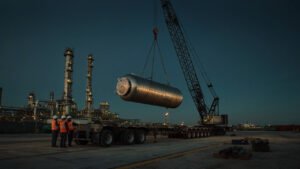
The main port at Ana Chaves Bay in the city of São Tomé has limited deep-water capacity, so it does not take the largest vessels directly. Heavy and oversized cargo typically transships through a larger West African hub and arrives on a smaller feeder vessel, and some loads are worked at anchorage with lightering when berth depth is the constraint. Barge and breakbulk handling, roll-on roll-off for wheeled units, and flat rack or open-top equipment for out-of-gauge pieces all come into play. Plan on a long routing, often five to seven weeks or more depending on the transshipment connection.
The Gulf of Guinea Oil Sector
São Tomé and Príncipe’s energy interest centers on offshore exploration in the Gulf of Guinea, including the Joint Development Zone it shares with Nigeria. That offshore activity drives demand for drilling equipment, supply-base gear, and project cargo, which often moves alongside the wider regional oil and gas logistics through nearby hubs.
Customs and Documentation
Exporting from Houston and importing into São Tomé and Príncipe takes an accurate document set: the commercial invoice, packing list, bill of lading, and certificate of origin, prepared so the cargo clears without a hold. São Tomé and Príncipe is a Portuguese-speaking nation, so Portuguese-language documentation often smooths clearance. A customs broker familiar with the islands and the regional transshipment hub keeps the paperwork aligned across both legs of the move.
The Move, Step by Step
The equipment leaves the Houston area by truck or rail to the port, loads onto a vessel sized for the cargo, and crosses the Atlantic toward the Gulf of Guinea. At the transshipment hub it transfers to a feeder vessel for the final leg to São Tomé. On arrival, crews inspect the cargo against the documents, offload with the right cranes and rigging, and verify it arrived intact before inland delivery. For a multi-unit project, project logistics keeps every leg on one schedule.
Working With Texas International Freight
Texas International Freight books vessel space, prepares the export filing, plans the transshipment, and coordinates customs and inland delivery on the islands. The same desk runs the wider Gulf of Guinea region, including lanes to Nigeria, so a project that spans more than one country sits with one team. Tell us the cargo and the destination, and we map the route.
Ship Your Equipment to São Tomé and Príncipe
Texas International Freight moves heavy equipment, oilfield machinery, and breakbulk cargo from Houston to São Tomé and Príncipe, with transshipment, customs, and inland delivery handled in house. Send us the equipment, dimensions, and delivery point, and we return a plan and a quote.
Contact Information:
- Phone: +1 877-489-9184
- Email: ship@txintlfreight.com
- Address: 11511 Katy Fwy #320, Houston, TX 77079
- Web Form: Request a Quote
Connect With Us:
How does heavy cargo reach São Tomé and Príncipe?
Because the main port has limited deep-water capacity, heavy and oversized cargo usually transships through a larger West African hub and arrives on a feeder vessel, with lightering at anchorage for some loads. Breakbulk, flat rack, and roll-on roll-off all come into play depending on the unit.
How long does shipping from Houston to São Tomé take?
Plan on a long routing, often five to seven weeks or more, because the cargo typically transships rather than sailing direct. Export filing, customs clearance, and inland delivery add to the timeline, and breakbulk or chartered moves can run longer.
What documents are required to import into São Tomé and Príncipe?
The core set is the commercial invoice, packing list, bill of lading, and certificate of origin. As a Portuguese-speaking nation, the islands often clear faster with Portuguese-language documentation, and a customs broker familiar with the route keeps the paperwork aligned.
Can you ship offshore oil and gas equipment to the islands?
Yes. The Gulf of Guinea, including the Joint Development Zone shared with Nigeria, drives demand for drilling and supply-base equipment. We move that gear as breakbulk or project cargo, coordinating it with the wider regional oil and gas logistics.
Do you handle the full move, including transshipment?
Yes. We plan the Houston export, the ocean leg, the transshipment to a feeder vessel, customs clearance, and inland delivery on the islands, coordinating every leg on one schedule so nothing stalls between connections.