
Shipping Lithium Battery Modules Safely Worldwide
From data centers in the desert to self-sufficient industrial parks, lithium battery modules do the heavy lifting for off-grid energy storage.
These are not the cells in your phone. They are massive, high-capacity storage units that can weigh thousands of pounds and power an entire operation, as backup or as primary supply.
Where do these modules come from, how big do they get, and what goes into shipping one into the US, especially to the remote sites that need them most? Here is how the move works.
Texas International Freight ships lithium battery modules into and across the US. We handle the hazmat compliance, the ocean and inland legs, and the customs as one job.
What Are Lithium Battery Modules
Lithium battery modules are the core of large-scale energy storage systems (ESS). They are assembled from multiple lithium-ion cells for high energy density in a compact form, then stacked into racks or containers to build the battery arrays used in:
- Mini industrial parks
- Microgrids and off-grid installations
- Solar and wind power storage
- Backup systems for critical infrastructure

Where Are They Made
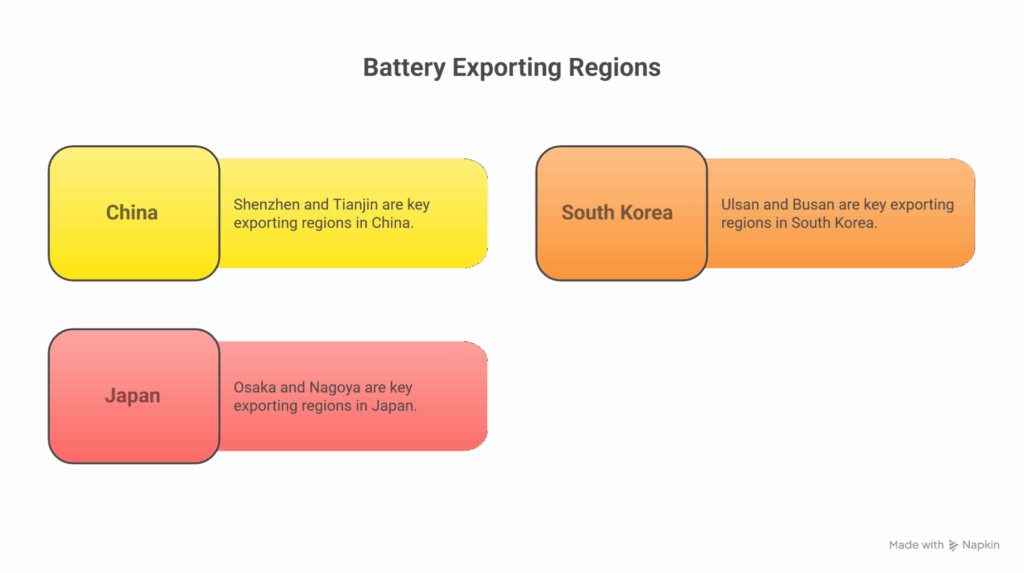
Some US companies build lithium modules domestically, but many of the largest units come from Asia, particularly China, South Korea, and Japan. Manufacturers like CATL, LG Energy Solution, and Panasonic ship modules in bulk to meet rising global demand.
How Big Can They Get
Forget car batteries. Industrial-grade lithium modules can be the size of a shipping container, and some weigh over 5,000 lbs per unit depending on capacity and configuration.
- Tesla Megapack: up to 3.9 MWh of storage per unit
- CATL EnerOne modules: scalable outdoor racks, each around 2,000 lbs
- LG RESU Flex systems: modular systems for commercial installations
Combined into arrays, these setups power entire facilities in isolated areas, think desert solar farms in Arizona or remote oil fields in Texas.
Why They Ship to Remote Sites
Many of these modules never see a city. They head to remote mini-industrial parks, rural data centers, isolated research facilities, and military or energy installations off the main grid. Those sites cannot lean on public utilities, whether for distance, reliability, or energy independence, and the modules give them storage and grid independence.
Shipping Into the U.S.
Large-format lithium batteries do not move like other heavy machinery. They are classified as hazardous materials, Class 9 under UN 3480/3481, for their fire risk and energy density. That means strict compliance with:
- U.S. Department of Transportation (DOT) regulations
- International Maritime Dangerous Goods (IMDG) Code
- IATA rules for air shipments, rare for large modules but relevant for smaller units
The points that matter most when shipping lithium battery modules:
- Proper packaging and labeling
- Shipping under UN specs with full documentation
- Battery management system (BMS) protection
- Shock and heat protection
- Customs clearance coordination
For larger shipments arriving by sea, breakbulk or containerized freight is standard. Once they reach US ports like Houston, Miami, or Savannah, they load onto flatbed trucks or lowboys for the run to inland sites.

Working With Texas International Freight
Moving lithium battery modules, especially the big ones, leaves no room for mistakes. We handle safe, compliant shipping of lithium-ion systems into and across the US: full logistics from Asia or Europe to your site, full hazardous-materials compliance, heavy-lift coordination, and inland freight to remote areas. From a desert data center to a microgrid build, we get your modules there safely and on time.
Ship Your Lithium Battery Modules
Texas International Freight ships lithium battery modules and energy storage systems worldwide as Class 9 hazardous materials, with UN-spec packing, documentation, heavy-lift, customs, and inland delivery handled in house. Send us the chemistry, capacity, UN number, and destination, and we return a compliant plan and a quote.
Contact Information:
- Phone: +1 877-489-9184
- Email: ship@txintlfreight.com
- Address: 11511 Katy Fwy #320, Houston, TX 77079
- Web Form: Request a Quote
Connect With Us:
Frequently Asked Questions
What types of lithium battery modules can you ship?
We handle most standard configurations of lithium-ion and lithium-metal battery modules, whether they’re standalone, packed with equipment, or contained in equipment. Key: you must provide full details (chemistry, Watt-hour rating, UN number, packaging state) so we can assess compliance.
Which regulatory frameworks apply to shipping lithium battery modules?
Shipping lithium batteries is considered shipping hazardous goods. For example, in the U.S., the Pipeline and Hazardous Materials Safety Administration (PHMSA) classifies lithium cells/batteries as hazardous materials under the Hazardous Materials Regulations (HMR).
Internationally, the International Air Transport Association (IATA) Dangerous Goods Regulations, the International Maritime Organization’s IMDG Code, and the UN Manual of Tests & Criteria (especially UN 38.3) are also relevant.
What are the key packaging, labelling and documentation requirements?
Some essential points:
The battery modules must have passed UN 38.3 testing unless otherwise exempted, to ensure safe transport.
They must be packed in strong rigid outer packaging; inner packaging must prevent short circuits, protect terminals, and withstand hazards of transport.
Proper labeling: e.g., Class 9 (miscellaneous dangerous goods) or other applicable labels, UN number (for lithium modules that are standalone: UN 3480; packed with equipment: UN 3481) depending on configuration.
Documentation: a Dangerous Goods Declaration (when required), proper declarations on waybills/airway bills, clear identification of the contents and regulatory class.
Are there shipping modes or destinations that are restricted?
Yes, some constraints:
Standalone lithium batteries (not in or with equipment) may be forbidden on passenger aircraft and permitted only on cargo-aircraft under stricter rules.
Some carriers impose additional restrictions or require prior approval for lithium shipments.
Sea freight and road freight may allow larger modules, but you must comply with IMDG for ocean and ADR for road (in Europe).
Always check destination country regulations: local/customs/regulatory bodies might impose additional rules beyond the international baseline.
What information do you need from me to get a quote or book the shipment?
We’ll need at least:
– Battery chemistry (Li-ion, Li-metal, etc.)
– Module capacity (Wh or Ah) and cell/panel configuration
– Whether the battery is shipped standalone, packed with equipment, or contained in equipment
– UN number (if known) and relevant test certification (UN 38.3 summary)
– Packaging state (e.g., terminals protected, rigid outer packaging ready)
– Mode of transport (air, sea, road), origin and destination
– Any special conditions (e.g., hazardous status, special approvals, consignment sizes)
What risks do I face if the shipment isn’t handled correctly?
Improper handling of lithium battery shipments can lead to serious issues:
Risk of fire or thermal runaway during transport, particularly if damaged, defective or improperly packed.
Regulatory non-compliance may lead to cargo rejection, heavy fines, carrier refusal, or shipment delays.
Reputational damage and insurance may be compromised if a hazardous incident occurs.
Why choose Texas International Freight for shipping lithium battery modules?
Because we specialise in logistics for hazardous and regulated goods:
We manage full packaging, documentation and logistics to ensure compliance.
We keep up-to-date with changing regulations across air, sea, road transport.
We offer tailored solutions depending on your battery size, type, destination and mode of transport.
Our goal: you focus on your product, we focus on safe, compliant shipping.
Are lithium batteries classed as dangerous goods?
Yes. Lithium-ion and lithium-metal batteries ship as Class 9 dangerous goods under UN3480 and UN3481, with IMDG rules for ocean and IATA rules for air. We classify, pack, and document each shipment to the right standard.
What is a UN38.3 test summary and do I need one?
UN38.3 is the safety test standard every lithium cell and battery must pass to ship. Carriers require the test summary before booking, and we confirm yours is in order before the shipment moves.
Does the state of charge matter for shipping?
Yes. Air cargo limits lithium-ion batteries to a state of charge at or below 30 percent, and ocean and road moves follow packing instructions tied to size and configuration. We plan the mode around the battery condition. For flooded and sealed lead acid units, see our wet battery pack shipping service.
Can you ship damaged, defective, or recalled batteries?
Damaged or recalled lithium batteries face strict handling rules and are barred from some modes. We assess the condition, arrange compliant packaging, and route the shipment by a method that accepts it.
What documents does a lithium battery shipment need?
A UN38.3 test summary, a safety data sheet, the dangerous goods declaration, proper UN-marked packaging, and the commercial invoice and packing list. We prepare the set and clear the cargo through our customs broker network.


