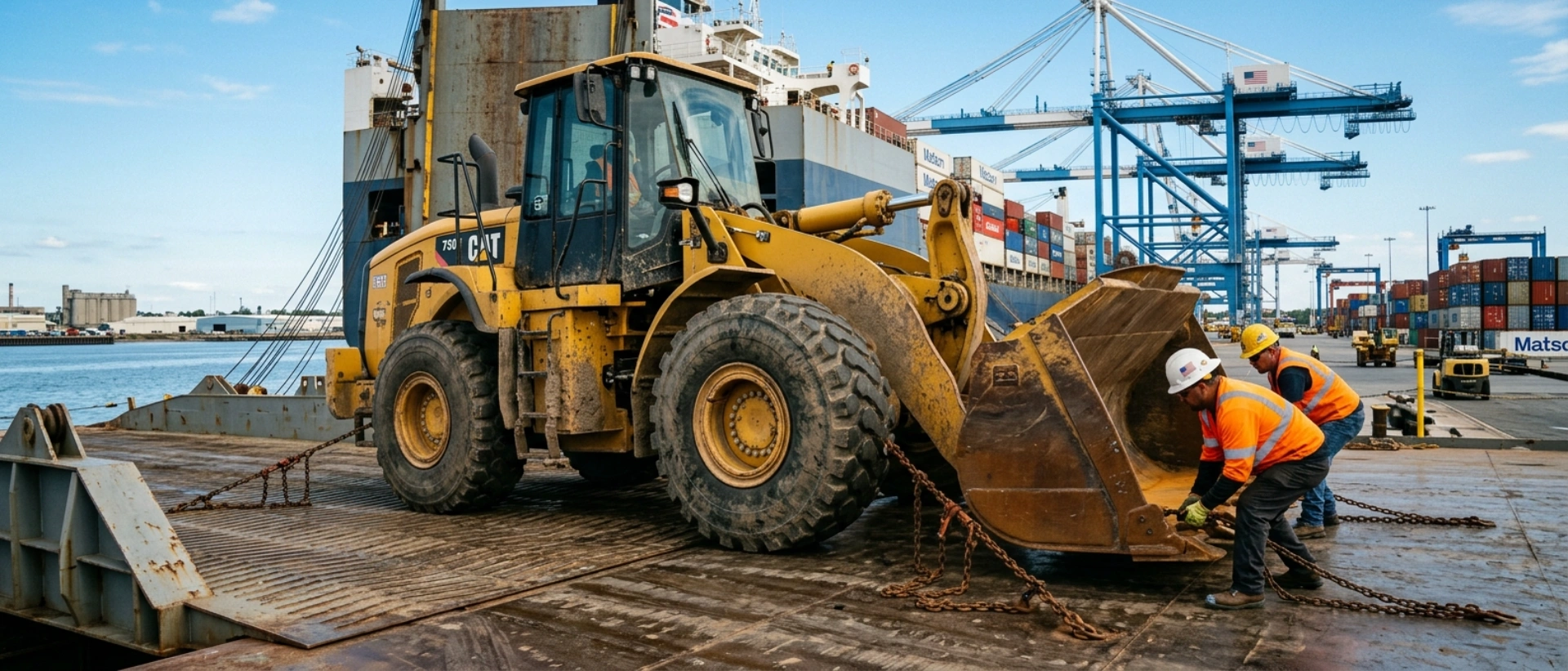
Wheel Loader Shipping and International Heavy Equipment Transport
You have a wheel loader to move across a border, maybe a Caterpillar 950 to a contractor overseas, maybe a row of Volvo L90s to a mine site. The machine is self-propelled, high in value, and oversized, so it does not move like ordinary cargo. The method you pick, the documents you file, and the destination country’s rules decide whether it lands on schedule or sits at the port.
Texas International Freight ships wheel loaders and heavy construction equipment from Houston and across the United States to ports worldwide. We handle the export filing, the ocean booking, the lashing at the terminal, and the customs clearance and delivery at the far end, on one file with one point of contact.
What Wheel Loader Shipping Involves
Wheel loader shipping is the international transport of articulated front-end loaders, machines like the Caterpillar 950, Komatsu WA320, Volvo L90, and John Deere 644, by ocean freight, inland trucking, or a combination of the two. Because these loaders are oversized, self-propelled, and carry high value, they need handling that standard cargo does not.
A forwarder who knows heavy equipment runs the chain end to end: the export filing with U.S. Customs and Border Protection, the vessel choice between RoRo and flat rack, the lashing and securing at the terminal, the ocean transit, and the customs clearance at the destination port. We coordinate each step, including the in-country move to the job site.
Choosing a Shipping Method: RoRo, Flat Rack, or Breakbulk
The three methods for moving a wheel loader overseas trade off cost, availability, and transit time.
| Method | Best for | Typical cost | Availability |
|---|---|---|---|
| RoRo (roll-on roll-off) | Self-propelled loaders in working order | Lowest per unit | Major ports worldwide |
| Flat rack | Loaders with attachments, or non-RoRo destinations | Mid-range | Any container port |
| Breakbulk and project cargo | Oversized or non-operational machines | Highest, quoted per project | Select ports, advance booking |
Roll-on roll-off vessels have open decks where equipment drives aboard under its own power or gets towed by a yard tractor, then sits chocked and lashed to the deck under SOLAS securing rules. RoRo is the standard choice for a running loader because it loads fast, costs the least per unit, and sails from major U.S. ports including Houston, Baltimore, Jacksonville, and Los Angeles.
A flat rack is a container floor without walls or a roof, a reinforced steel platform. The loader drives or is craned onto the rack and gets secured with chains and twist-locks rated to its gross weight. This fits when RoRo does not serve the destination port, or when buckets, forks, or attachments ship with the machine.
An oversized or non-running loader moves as breakbulk on a heavy-lift or project vessel. Transit runs longer and the booking goes in earlier, but it carries loads no other method will take.
Export and Import Documentation
Missing or wrong paperwork is the most common cause of customs delays on heavy equipment. Requirements vary by destination, but the standard export set for a US-origin wheel loader includes:
- Commercial invoice: describes the equipment, states the sale price and Incoterms, and identifies buyer and seller.
- Bill of lading: the contract with the ocean carrier, and the title document while the machine is in transit.
- Certificate of origin: certifies the country of manufacture, which sets the duty rate under many trade agreements.
- Title or certificate of ownership: proves the shipper’s right to export the machine.
- Electronic Export Information (EEI): filed through the Automated Export System with CBP for shipments above 2,500 dollars.
Some destinations ask for more: a phytosanitary certificate when the loader has worked in soil, a temporary import bond if it will return to the United States, or country import permits for construction machinery. We prepare the origin documents and coordinate with in-country agents for clearance at the destination port, and clean export packing and marking round out the set.
How the Shipping Process Works
- Quote and booking. Send the make, model, year, dimensions, and origin and destination. We confirm the method, route, and vessel, then quote all charges to the agreed Incoterms point.
- Inland trucking to port. We pull the oversize-load permit and move the loader from your yard to the terminal. For RoRo it goes to the marshaling yard, for flat rack it is craned at the container terminal.
- Export filing. We prepare the invoice, packing list, certificate of origin, and any destination documents, and file the EEI through AES before the vessel cutoff. You get copies of everything filed.
- Ocean transit. The loader sails on the booked vessel, and you track it. We confirm the arrival window at booking and update it if the schedule moves.
- Destination clearance. Our in-country agent files the import declaration, pays duties and taxes on your behalf or arranges a bond for temporary entry, and clears the machine for release.
- Final delivery. A local carrier runs the loader to your delivery address, we confirm receipt, and you get one consolidated invoice with no surprise charges.
Typical Transit Times by Destination
The ranges below are port-to-port estimates for RoRo and flat-rack sailings from US Gulf and East Coast ports. Add three to seven days for inland trucking and customs at each end. We move the same loaders on the cross-border lanes to Mexico and Canada by road.
| Destination region | Port-to-port transit | Major ports of entry |
|---|---|---|
| Mexico and Central America | 5 to 14 days | Veracruz, Altamira, Puerto Cortes |
| South America (east coast) | 14 to 25 days | Callao, Buenos Aires, Santos, Cartagena |
| West Africa | 18 to 30 days | Lagos (Apapa), Tema, Abidjan, Dakar |
| Europe | 14 to 22 days | Bremerhaven, Antwerp, Barcelona |
| Middle East | 22 to 35 days | Jebel Ali, Dammam, Aqaba |
| Asia-Pacific | 28 to 45 days | Singapore, Manila, Port Klang |
What Affects the Cost
- Dimensions and weight: ocean freight on heavy equipment is priced on size and gross weight, so a compact loader ships for less than a large articulated machine, and oversize attachments add to the rated measurements.
- Shipping method: RoRo is usually the cheapest, while flat rack and breakbulk cost more for the container, the crane handling, and the lashing labor.
- Port pair: the origin and destination ports set the base ocean rate, and inland trucking at both ends adds to the total.
- Duties and taxes: import duty on construction machinery runs from zero under a free trade agreement to twenty percent or more in some markets, and we advise the rate at inquiry.
- Timeline: standard bookings follow the vessel schedule and faster routing costs more, so build in about two weeks of lead time when you can.
- Cargo insurance: all-risk marine cover is quoted as a percentage of the declared value and protects the loader through loading, transit, and discharge.
Why Companies Use Texas International Freight
Most forwarders handle general cargo. A wheel loader needs someone who knows RoRo schedules, oversize trucking rules, and the destination country’s import rules for used construction machinery. Get one of those wrong and the shipment stalls and the cost climbs.
We focus on heavy construction equipment. We know which ports run reliable RoRo to West Africa, what the Philippines asks for on used-equipment imports, and which carriers hold their schedules on the routes we book. As an FMC-licensed forwarder in Houston, we run origin trucking, export filing, ocean freight, and destination customs as one team, so you get one invoice and one person to call. For a fleet moving to a single project, project logistics keeps every machine on one schedule.
Ship Your Wheel Loader With Texas International Freight
Send us the make, model, dimensions, weight, origin, and destination, and we confirm availability and quote within one business day.
Contact Information:
- Phone: +1 877-489-9184
- Email: ship@txintlfreight.com
- Address: 11511 Katy Fwy #320, Houston, TX 77079
- Web Form: Request a Quote
Connect With Us:
What documents are required to ship a wheel loader internationally?
The standard export set is a commercial invoice, packing list, bill of lading, certificate of origin, and the machine’s title or ownership certificate, plus an Electronic Export Information filing through the Automated Export System for shipments above 2,500 dollars. By destination you may also need a phytosanitary certificate when the loader has soil contact, a temporary import bond if it returns to the United States, or a country import permit for construction machinery. We confirm the exact list for your destination at booking.
Does a wheel loader ship by RoRo or in a container?
Most running wheel loaders ship by roll-on roll-off. The loader drives aboard or is towed by a yard tractor, then sits chocked and lashed to the deck, which is usually the lowest-cost route from major US ports. A flat rack is the choice when RoRo does not serve the destination or when attachments travel with the machine, and breakbulk covers oversized or non-running loaders. We match the method to the loader’s size, destination, and timeline.
How long does it take to ship a wheel loader internationally?
Port-to-port ocean transit runs roughly 5 to 14 days to Mexico and Central America, 14 to 25 days to South America, 18 to 30 days to West Africa, and 28 to 45 days to the Asia-Pacific. Add three to seven days for inland trucking and customs at each end. We give a specific window at booking.
How is a wheel loader secured during ocean freight?
On a RoRo deck the loader is chocked, lashed, and secured under SOLAS securing rules. On a flat rack it is held with chains and twist-locks rated to its gross weight, and the bucket and detachable attachments are secured separately or removed and crated. We provide lashing details on request.
What other construction equipment do you ship?
We ship the full range of heavy construction and industrial equipment: excavators, bulldozers, motor graders, compactors, skid steers, backhoes, cranes, forklifts, and agricultural machinery. The method is the same, RoRo or flat rack with full export documentation and destination clearance, sized to each machine.


