Heavy Equipment Hauling and Backhauling from Houston
You need a forklift moved across town, an excavator hauled across three states, or a transformer railed over a mountain range. Heavy equipment hauling covers all of it, and the right answer depends on weight, dimensions, route, and timing. Texas International Freight runs these moves daily out of Houston, by road, rail, and barge, for domestic delivery and for export through the Gulf ports.
The Trailer Matched to the Load
No single trailer hauls everything. Through our carrier network we source the equipment each load demands: multi-axle hydraulic platform trailers such as Goldhofers for the heaviest pieces, lowboys for tall machines that need deck height, stretch trailers for long loads, flat trailers for standard machinery, and squat beams and bolsters for concentrated weight. The trailer choice drives the permit picture, the route, and the price, so it gets decided first.
Backhauling: The Cost Saver
A truck that delivers a load and returns empty bills you for both directions. Backhauling fills that return leg with paying cargo, and a forwarder who works the backhaul market moves your machinery at a meaningful discount when your timing is flexible. We coordinate backhaul capacity across our carrier network for exactly this reason. Does your shipment have a hard date, or can it ride the cheaper leg?
Rail for the Heaviest Cargo
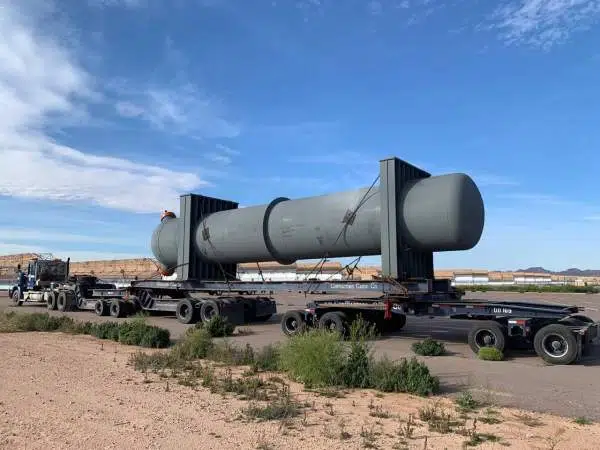
Some cargo outgrows the highway. We move extremely heavy pieces by rail, including LNG tanks and transformers, on the specialized railcars built for concentrated weight. A 132,000-pound LNG tank that cannot clear highway bridges rides the rails instead, and our team plans the transload at each end.
Barge for the Bulkiest
For extraordinarily heavy and bulky cargo moving along the Gulf Coast and the inland waterway system, barge transport carries what road and rail cannot. Refinery vessels, modules, and oversized fabrications move by water with crane plans at both banks.
Permits, Escorts, and Route Surveys
Every jurisdiction sets its own size and weight limits, convoy rules, and travel-time restrictions. Our heavy haul trucking desk secures the permits, contracts pole cars and police escorts when the load requires them, and runs route surveys to find the low bridge before the driver does. Oil and gas moves such as rig hauling, compressor packages, and mud systems follow this playbook on every lane.
From the Highway to the High Seas
Hauling rarely ends at a fence line. The same desk that trucks your machine to the Houston docks books the breakbulk or container space, handles export packing, and clears customs on both ends. Imports run the same path in reverse: we receive heavy equipment at the port, clear it, and haul it to your site. Cross-border work to Mexico and Canada rides the land bridges with the customs paperwork handled in advance.
Get Your Heavy Equipment Haul Booked
Texas International Freight hauls forklifts, excavators, compressors, transformers, and full project packages by road, rail, and barge. Regular Texas heavy haul lanes include the Permian Basin, Beaumont and Port Arthur, Corpus Christi, Laredo, Dallas-Fort Worth, and San Antonio and Austin. Send us the dimensions, weight, pickup point, and delivery point, and we return a routing and a quote.
Contact Information:
- Phone: +1 877-489-9184
- Email: ship@txintlfreight.com
- Address: 11511 Katy Fwy #320, Houston, TX 77079
- Web Form: Request a Quote
Connect With Us:
What trailer types haul heavy equipment?
Multi-axle hydraulic platforms such as Goldhofers for the heaviest loads, lowboys for tall machines, stretch trailers for long pieces, flat trailers for standard machinery, and squat beams and bolsters for concentrated weight. The load’s dimensions and weight pick the trailer.
What is backhauling and why does it cost less?
Backhauling fills a truck’s otherwise-empty return leg with paying cargo. Because the carrier already covers that lane, flexible-timing shipments riding the backhaul move at a discount compared with booking a dedicated truck.
When does heavy equipment move by rail or barge instead of truck?
When weight or dimensions outgrow the highway. LNG tanks, transformers, and refinery vessels that cannot clear bridges or axle limits ride specialized railcars or barges, with transloads planned at each end.
Do oversized loads need permits and escorts?
Yes. Each state sets its own size and weight limits, and loads beyond them need permits, sometimes pole cars or police escorts, and route surveys to clear bridges and overhead obstructions before the truck rolls.
Can the same company handle the haul and the export?
Yes, and one desk beats two. We truck the machine to the Houston docks, book the ocean leg, handle export packing and customs, and run the reverse path for imports, so a schedule change anywhere gets managed once.